
About Mitovaryn Labs
Science-Informed Wellness, Explained With Clarity
Mitovaryn is building a more transparent way to explore emerging wellness compounds: document product quality, distinguish research from proven outcomes, surface important safety limits and give customers the context to make informed choices.
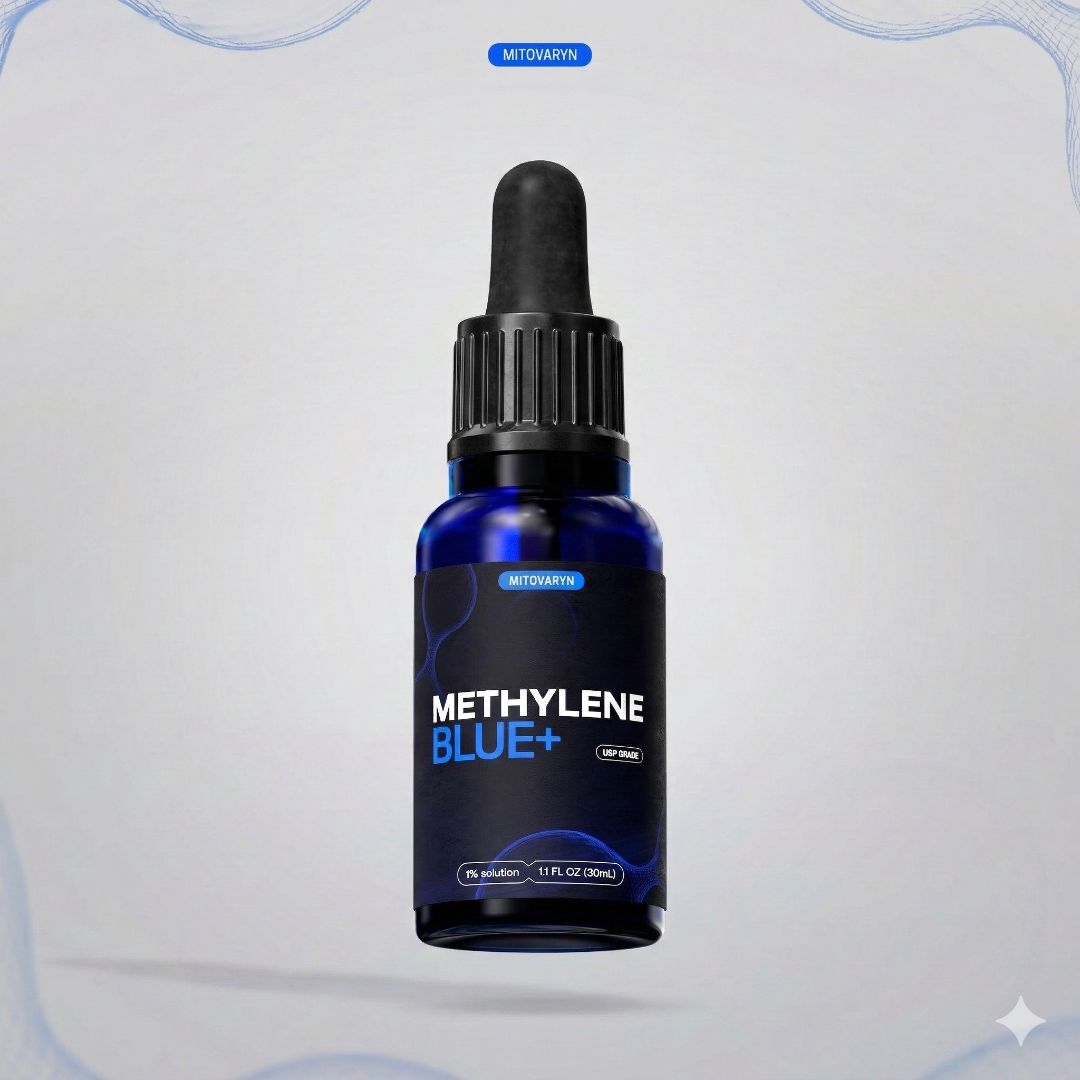
Quality, evidence and personal suitability are three different questions. Mitovaryn's goal is to help customers examine each one—without treating a laboratory report as proof of efficacy or an early study as a medical promise.
Our mission: make emerging wellness easier to evaluate
Mitovaryn serves people who want to understand compounds receiving attention in longevity, performance and recovery communities. Curiosity is welcome. Certainty still has to be earned.
Our role is to offer carefully presented products while building an educational layer around them. That means helping customers ask better questions: What is the compound? What was actually studied? Was the research performed in people? What did the test measure? What does the product documentation establish? Who should avoid it?
Clarity before hype
A mechanism is not a guaranteed benefit, a testimonial is not a clinical trial and popularity is not proof.
Quality you can examine
Testing should be read by analyte, method, result, limit, lot and date—not reduced to an unexplained badge.
Choice with context
Customers deserve both the case for interest and the reasons a product may be inappropriate for them.
The standard we are building toward
Trust is not created by repeating “science-backed.” It comes from making claims traceable and keeping conclusions proportional to the research.
| Principle | What it looks like in practice | Why it matters |
|---|---|---|
| Traceability | Connect test documentation to the named product or lot whenever that information is available. | A report without a clear product connection is difficult to evaluate. |
| Specificity | State whether a report covers identity, assay, microbes, heavy metals or another defined analyte. | “Lab tested” does not identify what was tested. |
| Evidence hierarchy | Label cell, animal, observational and controlled human evidence separately. | Early research should not be presented as a proven human outcome. |
| Safety visibility | Put major interactions, contraindications and uncertainty where customers can find them. | A compound can be interesting and still be unsuitable for a particular person. |
| Correctability | Review content as research, labels and regulatory information change. | Responsible education must be able to evolve. |
Our working rule: say exactly what a study or document supports—and just as clearly what it cannot establish.
What product quality means—and what it does not mean
Product quality starts with identity, composition, concentration, manufacturing controls, packaging, storage and testing. The relevant checks depend on the ingredient and dosage form.
| Quality question | Useful evidence | Boundary |
|---|---|---|
| Is the named ingredient present? | An appropriate identity method and a report tied to a defined sample. | Identity does not prove a health benefit. |
| How much was measured? | An assay or concentration result with units and acceptance criteria. | Concentration alone does not establish a safe or effective dose. |
| Were contaminants assessed? | Named panels such as heavy metals or microbiological testing, with methods and limits. | A finite panel cannot prove the absence of every possible contaminant. |
| Does the report match my product? | Lot or batch linkage, report date, laboratory identity and sample description. | One result does not automatically describe every past or future batch. |
| Does “USP grade” settle everything? | A clear specification and methods relevant to the material being assessed. | A grade term is not FDA approval, clinical validation or proof of individual suitability. |
Our laboratory-testing guide explains how to read reports, while Methylene Blue lab results organize product-specific documentation. The aim is informed inspection, not blind reliance on a seal or slogan.
How we discuss science without flattening it
Different research designs answer different questions. Mitovaryn's learning center is being developed to show that hierarchy inside each topic—not hide it in fine print.
| Evidence type | What it can help answer | What it cannot prove alone |
|---|---|---|
| Mechanistic chemistry | How a molecule may participate in a reaction or pathway. | That the pathway produces a meaningful benefit in people. |
| Cell culture | Whether a controlled exposure changes selected cellular endpoints. | Absorption, whole-body safety or clinical effectiveness. |
| Animal research | How a hypothesis behaves in a living model. | That humans will receive the same benefit or tolerate the same exposure. |
| Observational human data | Whether exposure and outcome are associated in a population. | That the exposure caused the outcome. |
| Controlled human trial | Whether a defined intervention changed prespecified outcomes under the study conditions. | That every person, dose, formulation or use case will respond the same way. |
Quality is not efficacy. A well-characterized product may reduce uncertainty about what is in the container. Only appropriate outcome research can determine whether it produces a claimed benefit.
Our current product focus
Mitovaryn focuses on a small number of compounds with strong public interest and complex evidence. Each deserves its own product documentation, safety context and research pathway.
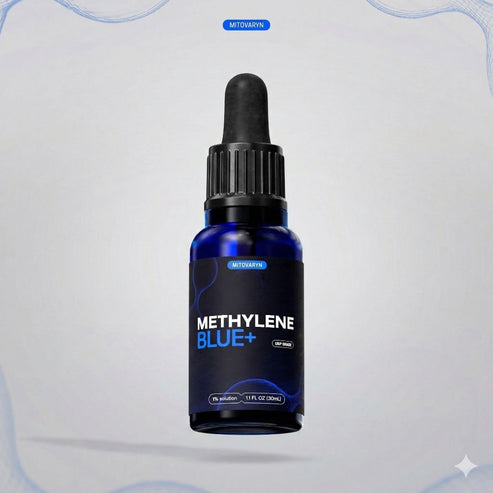
Methylene Blue
A redox-active compound with established medical use in specific prescription settings and broader emerging research. Those contexts do not automatically validate oral wellness claims.
View Methylene Blue →
BPC-157
A synthetic peptide-related compound discussed for recovery and gut support. Human evidence remains limited, and legal, regulatory and sport-governance questions require care.
View BPC-157 →Customers exploring these categories can begin with what methylene blue is, methylene blue safety and purity, what BPC-157 is and the BPC-157 FAQ.
Responsible-use boundaries belong in the main story
Educational content and product quality cannot replace individualized medical review. Important risks can depend on medications, medical conditions, pregnancy, sport participation and local regulation.
| Context | Why it deserves attention | Where to continue |
|---|---|---|
| Methylene blue and serotonergic drugs | Prescription labeling warns about serious or fatal serotonin syndrome with serotonergic medicines and opioids. | Methylene blue safety guide |
| G6PD deficiency | Methylene blue prescription labeling identifies a risk of hemolysis and contraindicates use in G6PD deficiency. | Responsible-use guidance |
| BPC-157 evidence and regulation | Research interest should not be confused with an approved therapeutic use, and rules can vary by jurisdiction and change over time. | Peptide legality explained |
| Competitive sport | Athletes are responsible for prohibited-substance and governing-body rules that may differ from consumer-product rules. | BPC-157 for athletes |
| Pregnancy, breastfeeding or medical complexity | Population-specific safety data may be absent or labeling may identify harm. | Consult the treating clinician or pharmacist before use. |
Do not use marketing copy to override medical advice. Do not stop or alter prescribed medication to make room for a supplement. A qualified clinician or pharmacist should review relevant medicines, conditions and symptoms.
Education is part of the product experience
Customers should not have to decode a research paper, certificate of analysis or regulatory document alone. Our content project is designed to answer high-intent questions while connecting each answer to the evidence and safety pages that belong beside it.
Start with definitions
Explain what the compound is, how it is described and which terms are often used imprecisely.
Map the evidence
Show the research model, route, dose, comparator and measured outcome before interpreting the result.
Connect the next question
Internal learning paths lead from benefits and uses to safety, dosing context, testing and claim evaluation.
Explore the Methylene Blue guide hub or the BPC-157 guide hub. For claim evaluation, see how to read BPC-157 claims online and methylene blue uses.
A straightforward customer experience
Trust continues after checkout. Customers should be able to understand delivery expectations, locate an order, ask a question and review return terms without hunting through the site.
| Need | Mitovaryn resource | Best time to use it |
|---|---|---|
| Product or order question | Contact Mitovaryn | Before purchase or whenever an order needs human support. |
| Delivery expectations | Shipping policy | Before ordering and while planning for delivery. |
| Shipment status | Track your order | After tracking information has been issued. |
| Return or refund terms | Refund policy | Before purchase or when considering a return. |
| Recurring-order terms | Subscription policy | Before starting, changing or cancelling a subscription. |
Policy terms control eligibility and timing. Review the current policy rather than relying on a promotional summary.
What we will not ask you to believe
A trustworthy brand does not need invented certainty. The following statements demand evidence beyond a product page, a review or a laboratory report.
| Claim | Why it is not enough | Our standard |
|---|---|---|
| “Everyone feels it immediately” | Individual experiences vary, and a felt effect does not prove a health outcome. | No guaranteed response |
| “Lab tested means clinically proven” | Product testing and efficacy research answer different questions. | Separate the evidence |
| “Natural means safe” | Origin does not determine dose, interaction or toxicity. | Assess the actual compound |
| “A cell study proves the benefit” | Cells do not reproduce human absorption, metabolism, behavior or clinical outcomes. | Name the model |
| “A testimonial proves causation” | Reviews cannot control for expectations, other changes or natural fluctuation. | Treat experience as experience |
The promise we can make: we will keep working to make product information easier to inspect, research easier to interpret and important uncertainty harder to miss.
Frequently asked questions about Mitovaryn
What is Mitovaryn?
Mitovaryn is a wellness brand focused on emerging compounds, product-quality documentation and evidence-aware education. Its current core categories include Methylene Blue and BPC-157.
What makes Mitovaryn different?
Mitovaryn is building product pages and learning paths that separate quality testing, scientific evidence, safety and personal suitability instead of treating them as one claim.
Are Mitovaryn products third-party tested?
Testing and available documentation should be checked by product and lot. Use the Lab Tests and product-specific results pages to see which sample, analytes, methods, dates and limits a report covers.
What does USP grade mean?
A USP-related grade claim should be supported by relevant specifications and methods. The term does not by itself mean FDA approval, proven effectiveness or safety for every person.
What is a certificate of analysis?
A certificate of analysis summarizes tests performed on a defined sample. Its value depends on sample identity, lot linkage, methods, analytes, results, acceptance limits and laboratory information.
Does a clean lab report prove that a product works?
No. A report may support identity, concentration or results for listed contaminants. It cannot replace controlled outcome research or establish that a product is appropriate for an individual.
How does Mitovaryn evaluate research claims?
The learning center distinguishes mechanistic, cell, animal, observational and controlled human evidence, then checks the formulation, route, dose, comparator and measured endpoint.
Are Mitovaryn products safe for everyone?
No wellness product should be assumed safe for everyone. Medicines, medical conditions, pregnancy, breastfeeding, allergies, age and sport rules can change suitability.
Can methylene blue be combined with antidepressants?
Methylene blue can inhibit MAO-A and prescription labeling warns about serious or fatal serotonin syndrome with serotonergic drugs. Do not combine it with an antidepressant or alter medication without the treating prescriber or pharmacist.
Can competitive athletes use BPC-157?
Athletes must check the current prohibited list, their governing body's rules and any therapeutic-use requirements. Consumer availability does not determine anti-doping status.
What is Mitovaryn's return policy?
Eligibility, deadlines, exclusions and instructions are set by the current Refund Policy. Review that policy before ordering and contact support if a specific purchase needs clarification.
How can I contact Mitovaryn?
Use the Contact page for product, order and support questions. For shipment progress, use the Track Your Order page once tracking information is available.
Explore Mitovaryn
- DailyMed: Methylene Blue Injection prescribing information. Current prescription safety context; not an oral wellness protocol.
- U.S. FDA Pharmacy Compounding Advisory Committee briefing document. July 2026 regulatory and evidence discussion for BPC-157-related bulk substances; advisory materials do not constitute an approved therapeutic use.
Start with the product—and keep the context
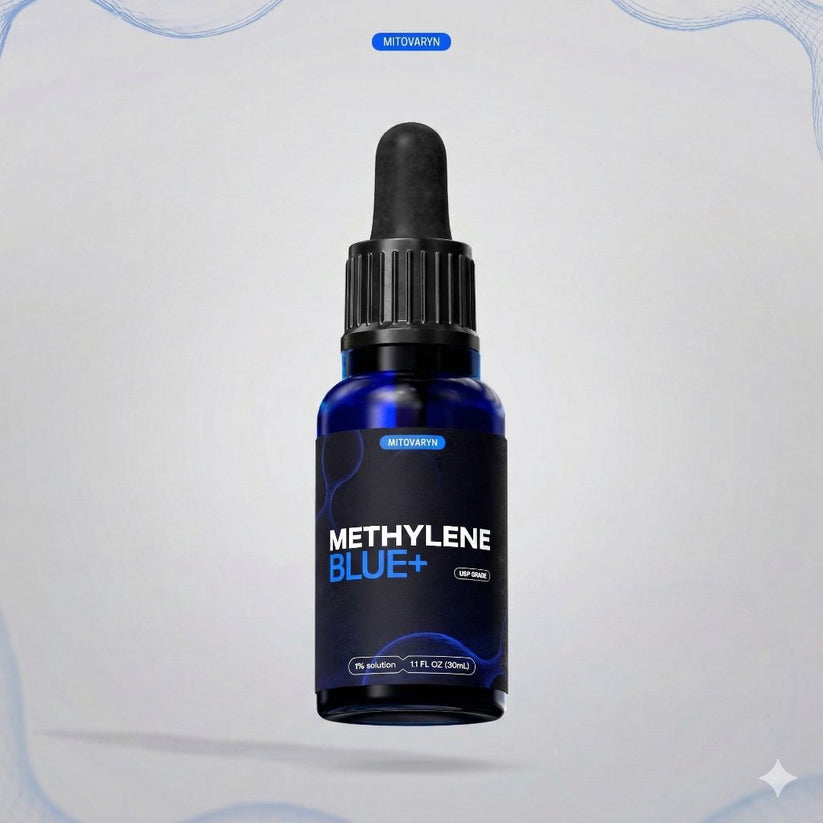
Explore Mitovaryn Methylene Blue alongside its testing, safety and education resources. A responsible choice considers what is in the bottle, what the evidence shows and whether the compound fits the individual.
Medical disclaimer: Educational content only—not medical advice, diagnosis or treatment. Products and statements have not been evaluated to diagnose, treat, cure or prevent disease. Consult a qualified professional who knows your medications and medical history before use.