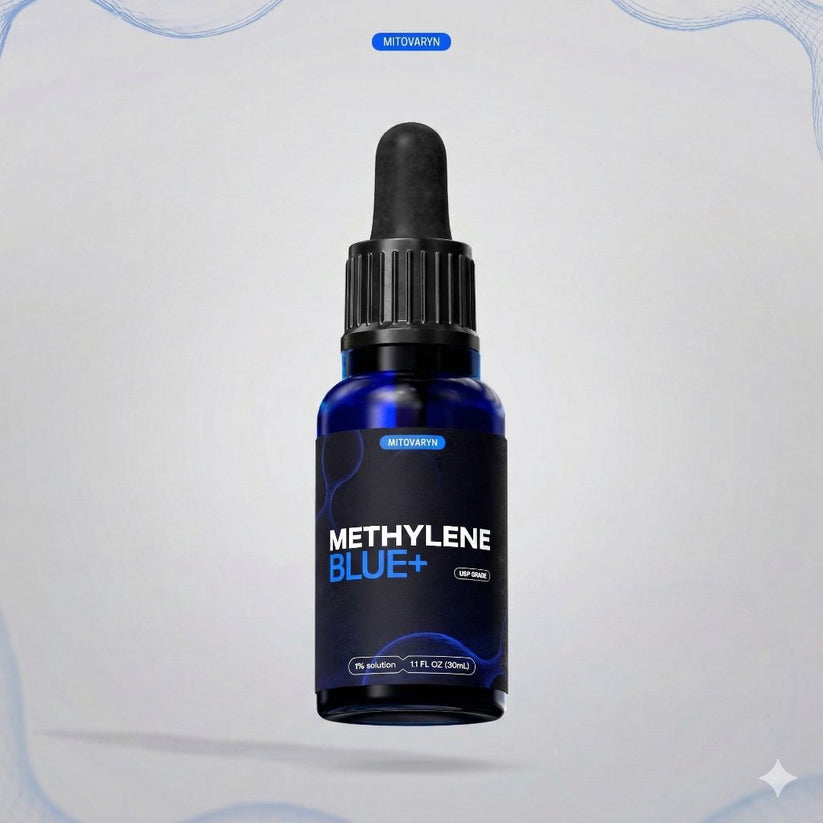
Mitovaryn Methylene Blue Learning Center
Methylene Blue Guides: Evidence, Safety, Uses and Research Library
Explore Mitovaryn’s evidence-led methylene-blue library—from foundational chemistry and approved medical use to cognition, mitochondria, performance, longevity, skin, dosage, purity and drug interactions.
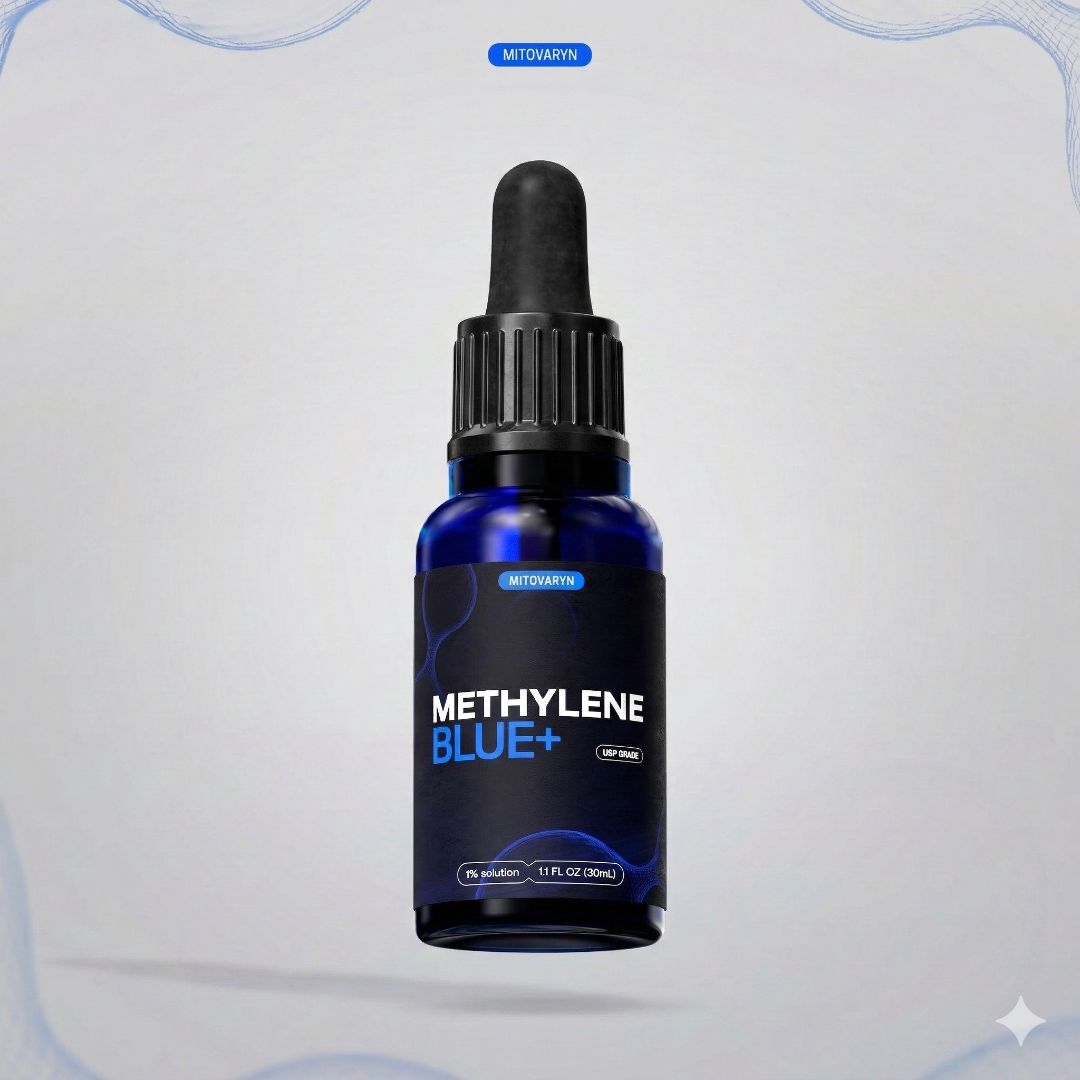
New to methylene blue? Begin with what it is, how it works, what it is approved to treat and whether it may be safe with your medicines. Then choose the topic-specific guide that matches your question. Research interest is not the same as an approved use, and product purity does not replace individual safety screening.
Start here: methylene blue essentials
These foundational guides establish the vocabulary and evidence boundaries used throughout the library.
What is methylene blue?
Learn its chemical identity, redox properties, approved medical role, research areas, formulations and core safety issues.
How methylene blue works
Separate its established methemoglobinemia mechanism from mitochondrial, cognitive and nitric-oxide research.
Methylene blue uses
Compare approved, clinician-directed, experimental, cosmetic and unsupported uses without blending their evidence.
What are the benefits?
Review commonly claimed benefits by outcome, population, formulation, research stage and clinical relevance.
One rule for every guide: evidence must match the exact claim, population, formulation, route, exposure and time frame. A cellular mechanism cannot by itself prove a consumer outcome.
Safety, dosage, purity and product quality
Use this section before interpreting a benefit claim or considering a product. Current U.S. prescription labeling carries a boxed warning for serious or fatal serotonin syndrome with serotonergic drugs and opioids and identifies G6PD deficiency as a contraindication for methylene blue injection.1
Clinical safety
Screen interactions, contraindications and urgent symptoms before discussing routine use.
Dosage and concentration
Understand the difference between concentration, measured volume, drops and a clinically appropriate dose.
Product quality
Audit identity, assay, concentration, impurities, microbial quality, packaging, stability and lot traceability.
Misconceptions and red flags
Learn why “99% pure,” “low dose,” “FDA registered” and anecdotal results cannot answer every quality or safety question.
Medication warning: do not stop an antidepressant, opioid or another prescribed medicine to create a self-directed washout. A prescriber or pharmacist should review prescriptions, over-the-counter products, supplements and recently discontinued medicines.
Brain health, cognition, memory and mood
Methylene blue attracts cognitive interest because of its redox chemistry and proposed effects on cellular metabolism. Direct human evidence is limited. A small randomized study in 26 healthy adults reported task-related fMRI changes and a 7% improvement on one memory-retrieval measure after a single administration; it did not establish durable cognitive enhancement or treatment of a disorder.2
Memory, attention and mental performance
Mood and attention topics
These pages audit the evidence and safety; they are not treatment recommendations.
How it differs from familiar options
Do not equate a scan with a life outcome
Brain activation, mitochondrial activity, subjective clarity and objective performance are different endpoints. Look for replication and real-world relevance.
Mitochondria, ATP and cellular pathways
These guides examine the biochemical rationale behind many methylene-blue claims. They distinguish redox cycling and experimental electron transfer from demonstrated human outcomes.
Energy-pathway fundamentals
Redox and inflammatory claims
| Research phrase | Question it raises | What it does not prove |
|---|---|---|
| Electron carrier | Under which conditions can the molecule accept and donate electrons? | That it repairs every dysfunctional mitochondrion. |
| ATP support | Did a matched experiment measure ATP or respiration? | Higher whole-body energy or productivity. |
| Antioxidant | Which redox marker changed, at what concentration? | Universal protection from oxidative damage. |
| Oxygen efficiency | Was oxygen delivery, extraction, consumption or performance measured? | A VO2-max or endurance improvement. |
Exercise, oxygen and athletic performance
Mechanistic plausibility should not be mistaken for sports-performance evidence. These articles evaluate the outcome actually measured and distinguish medical oxygen chemistry from performance in healthy athletes.
Training and endurance
Creatine and performance stacks
Check whether each component has independent evidence, overlapping risks and a reason to be combined.
Longevity, biological age and skin
Anti-aging language often stretches cell, tissue or cosmetic findings into whole-body longevity claims. Use these guides to keep endpoint and formulation distinctions visible.
Aging and lifespan claims
Topical and cosmetic research
Route boundary: a topical experiment does not establish an oral result, and an oral or intravenous study does not establish cosmetic safety. Formulation, concentration, exposure and staining all matter.
Comparisons, combinations and broader context
Choose by evidence, not novelty
A stack increases the number of variables. Evaluate each ingredient, purpose, interaction, concentration and adverse-effect signal separately before attributing a result to the combination.
Choose the right guide for your question
| If you are asking… | Start here | Then read |
|---|---|---|
| What is this molecule? | What is methylene blue? | How it works |
| Is it safe with my medications? | Drug interactions | Full safety guide |
| How do I read the concentration? | Concentration chart | Dosage evidence guide |
| How do I assess purity? | Safety and purity | Lab results |
| What does the cognition research show? | Cognitive support | Memory evidence |
| Does it support mitochondria? | Mitochondrial mechanism | ATP claims |
| Could it improve exercise? | Athletic performance | VO2-max evidence |
| Is an anti-aging claim credible? | Anti-aging evidence | Longevity evidence |
How Mitovaryn’s guides grade a claim
A useful article should make it easy to see where a conclusion comes from and where inference begins.
| Check | What the guide asks | Why it matters |
|---|---|---|
| Outcome | Was the claim itself measured, or only a related pathway? | Mechanisms and outcomes are not interchangeable. |
| Population | Cells, animals, healthy adults or people with a defined condition? | Results may not transfer across populations. |
| Intervention | Which chemical form, formulation, route, concentration and exposure? | Ingredient names alone do not establish equivalence. |
| Design | Was there randomization, blinding, a comparator and adequate sample? | Bias and chance can resemble an effect. |
| Duration | Acute experiment or repeated use with follow-up? | One administration cannot establish long-term benefit or safety. |
| Replication | Did independent studies find a similar result? | One small study is a signal, not a settled conclusion. |
| Safety | Were interactions, contraindications and adverse effects addressed? | A benefit-only explanation is incomplete. |
Methylene blue guides: FAQ
Where should I start learning about methylene blue?
Start with what methylene blue is, how it works, its approved use and the safety-and-interactions guide before moving to a specific benefit topic.
What is methylene blue?
Methylene blue, or methylthioninium chloride, is a synthetic thiazine dye and redox-active drug that can accept and donate electrons.
What is methylene blue approved to treat?
Current U.S. prescribing information approves methylene blue injection for treating acquired methemoglobinemia in adults and children.
How does methylene blue work?
It undergoes redox cycling. Its established medical mechanism reduces methemoglobin, while mitochondrial and cognitive mechanisms remain broader research areas.
Are methylene blue’s wellness benefits proven?
No broad wellness conclusion is established. Evidence varies by claim, population, formulation, route, exposure and outcome.
Is methylene blue safe?
Safety depends on the exact product, route, exposure, medicines and health factors. It has clinically important contraindications and interaction risks.
Which medicines can interact with methylene blue?
Serotonergic drugs, certain opioids and dextromethorphan are important concerns. A prescriber or pharmacist should review all medicines and supplements.
Where can I learn about methylene blue dosage?
Use the dosage guide, concentration chart and drop-count guide to understand label math and evidence without treating them as personalized instructions.
How do I evaluate methylene blue purity?
Check identity, assay, finished-product concentration, relevant impurities, microbial quality, lot linkage, laboratory methods, packaging and stability.
What does the research say about brain health?
Mechanistic research and one small acute healthy-adult study create interest, but durable cognitive enhancement and disease treatment are not established.
Is methylene blue proven for athletic performance?
No. Oxygen and mitochondrial mechanisms do not by themselves prove improved VO2 max, endurance, strength or recovery in healthy athletes.
How should I evaluate a methylene-blue article?
Check whether its outcome, population, formulation, route, design, duration, replication and safety evidence match the conclusion.
Core scientific and medical sources
Use the library, then inspect the product
Explore Mitovaryn Methylene Blue’s exact formula, concentration and available documentation. Product transparency supports an informed quality review; it does not guarantee a benefit, establish a personal dose or replace medical screening.