
Mitovaryn Evidence Guide
Methylene Blue for Longevity: What the Evidence Actually Shows
Methylene blue is discussed in longevity circles because it interacts with mitochondrial and redox biology. That mechanism is scientifically interesting—but it is not proof that oral methylene blue extends human lifespan or healthspan.
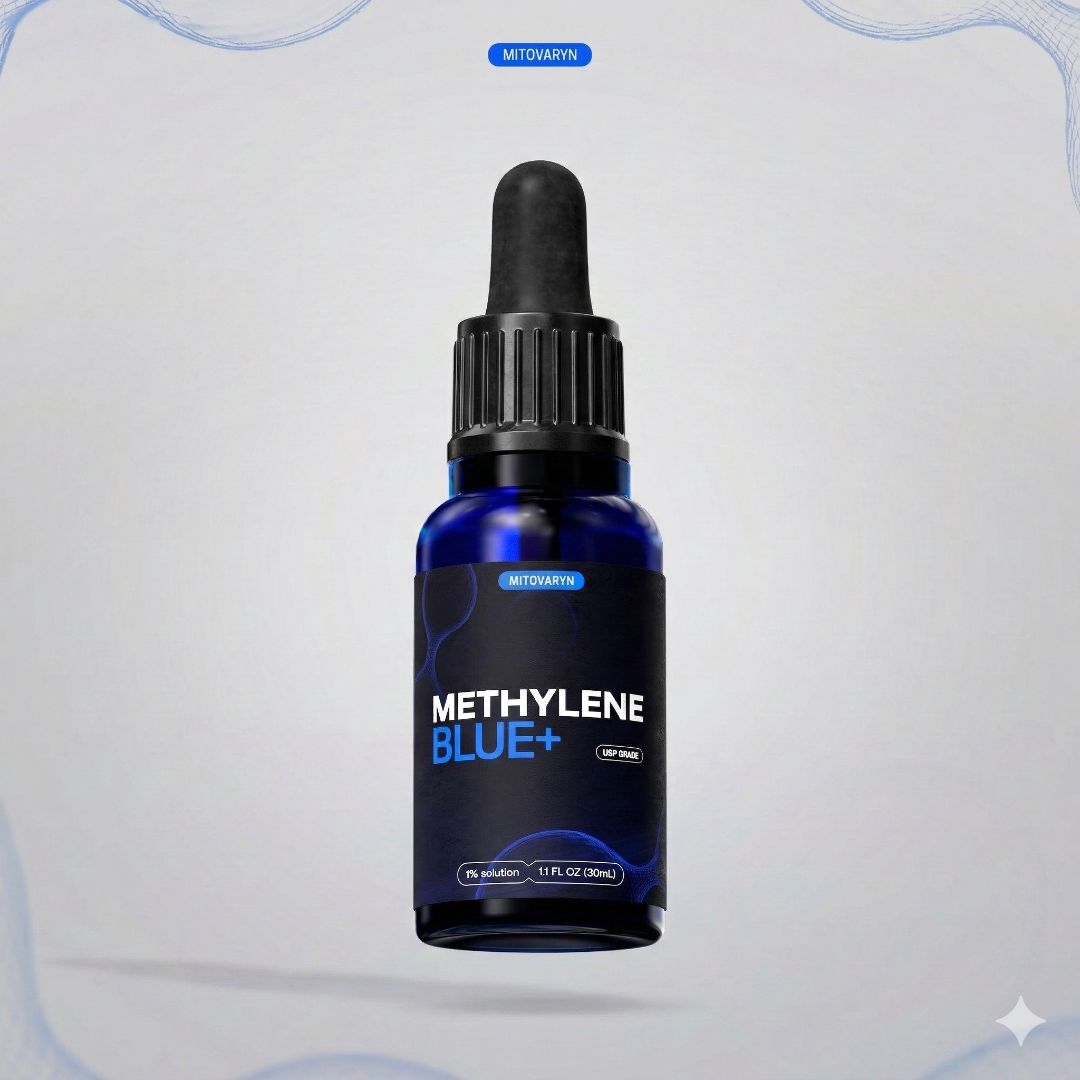
No controlled human trial has shown that oral methylene blue makes people live longer or preserves healthspan. A rigorous mouse study found no change in median lifespan in either sex and only a small increase in maximum lifespan among females. Cell and tissue-model findings explain the research interest, but they cannot establish a human anti-aging effect.
Review the product separately from longevity claims
Check the formulation, concentration and available documentation. Product quality can be evaluated; human lifespan extension has not been demonstrated.
Start by defining the outcome
“Longevity” can refer to several different outcomes. Treating them as interchangeable makes weak evidence look stronger than it is.
Lifespan
How long an organism lives. Median lifespan describes the typical survival point; maximum lifespan describes the longest-lived portion of a group.
Healthspan
Time lived with preserved function and without major disability or disease burden. It requires functional and clinical outcomes—not only a laboratory marker.
Aging biomarkers
Measurements associated with biological processes of aging. A changed marker may be useful, neutral or misleading unless it predicts outcomes that matter.
A longevity claim needs a longevity outcome. Mitochondrial respiration, oxidative-stress markers, cell proliferation, memory-task performance and skin-model thickness are not substitutes for human survival, disability-free years or validated healthspan endpoints.
The evidence at a glance
The research is best described as mechanistically interesting and preclinical—not as evidence of a proven human geroprotector.
| Evidence | Main finding | What it means for longevity |
|---|---|---|
| Controlled human lifespan trial | Not established | No evidence that oral methylene blue extends human lifespan or healthspan. |
| Heterogeneous-mouse lifespan study | No change in median lifespan in males or females; maximum lifespan increased 6% in females only. | Narrow animal signal Not a replicated human outcome. |
| Human skin cells and 3D skin models | Changes in oxidative stress, senescence-related measures and model-specific skin endpoints. | Preclinical Does not show that oral use slows whole-body aging. |
| Long-term aging-mouse bone study | Methylene blue did not prevent age-related bone loss in the studied models. | A plausible mitochondrial strategy did not improve this aging outcome. |
| Isolated rat-liver mitochondria | Certain experimental conditions produced uncoupling and lower ATP generation. | Mitochondrial effects are context- and dose-dependent, not inherently beneficial. |
What the mouse lifespan study found
The National Institute on Aging Interventions Testing Program evaluated methylene blue in genetically heterogeneous mice alongside other candidate interventions. Methylene blue did not alter median lifespan in males or females. It produced a statistically significant 6% increase in maximum lifespan in females, but not males.[1]
This is more informative than a cell experiment because the outcome was actual survival in a mammal. It is still not proof of human benefit:
- The result was limited to one survival metric and one sex.
- Median lifespan—the more representative survival measure—did not improve.
- A single animal result may not replicate or translate across species.
- The mouse exposure cannot be converted directly into a consumer oral protocol.
Do not rewrite “female maximum lifespan increased 6%” as “methylene blue extends lifespan.” That shorter sentence removes the neutral median result, the sex difference, the model and the uncertainty.
What the cell and skin research can—and cannot—show
A frequently cited 2017 study exposed cultured human skin fibroblasts and reconstructed 3D skin models to methylene blue. The researchers reported lower mitochondrial oxidative-stress signals, changes in senescence-related measures, greater cell proliferation and several favorable skin-model endpoints.[2]
The experiment helps generate hypotheses about redox biology and topical skin applications. It did not test:
- oral methylene blue in people;
- whole-body biological aging;
- age-related disease, disability or mortality;
- whether the observed cellular changes remain beneficial over years.
“Human cells” does not mean “human clinical trial.” Cells in a dish lack the absorption, metabolism, circulation, immune signaling, organ interactions and long-term tradeoffs of a living person.
Why mitochondria create interest—but not proof
Mitochondrial dysfunction is one recognized feature of aging biology.[5] Methylene blue can accept and donate electrons and has been studied as an alternative redox carrier under particular experimental conditions. That creates a plausible route to changes in respiration, reactive oxygen species and cellular stress responses.
Three reasoning steps must remain separate:
Mechanism
The compound changes a mitochondrial or redox process under specified conditions.
Functional effect
The change improves a meaningful outcome in an intact organism without offsetting harm.
Longevity effect
The improvement produces longer life or better healthspan in humans.
Evidence for step A does not automatically establish B or C. A 2020 rat-liver study illustrates the problem: under its tested conditions, methylene blue uncoupled oxidative phosphorylation, inhibited electron transfer and reduced ATP generation.[4] This does not prove that every exposure is harmful; it shows why “supports mitochondria” is too simple to serve as a longevity conclusion.
The human evidence gap
Human methylene-blue research has examined specific medical, neurological, cognitive or imaging contexts. Those studies can answer their own questions, but they were not designed to determine whether routine oral use slows aging or extends life.
| A study may measure | It can support | It cannot establish by itself |
|---|---|---|
| A short cognitive task | Performance under that protocol and time window. | Prevention of cognitive decline or dementia. |
| Brain imaging | A change in a specified imaging signal. | Longer life, preserved independence or disease prevention. |
| Oxidative-stress marker | A biochemical effect under the tested conditions. | Net long-term benefit across organs and systems. |
| Cellular senescence marker | A model-specific change associated with senescence. | Slower biological aging in a person. |
| A disease-specific endpoint | A conclusion about the studied population and indication. | General anti-aging effects in healthy adults. |
The practical conclusion is not that methylene blue can never affect a longevity-relevant pathway. It is that the clinically important longevity question remains unanswered.
What convincing longevity evidence would require
A credible human study would need more than an attractive mechanism or a before-and-after biomarker panel. At minimum, researchers would need:
- prospective randomization and an appropriate control group;
- adequate sample size and follow-up for the intended outcome;
- a defined oral formulation, concentration, exposure and adherence method;
- pre-specified functional or clinical endpoints, not only exploratory markers;
- systematic monitoring for drug interactions and adverse effects;
- transparent reporting of all outcomes, withdrawals and conflicts;
- replication by independent research groups.
For healthspan, meaningful endpoints could include incident disease, frailty, physical or cognitive function, disability-free survival and quality of life. For lifespan, mortality must actually be measured. A commercial “biological age” score is not a substitute unless changes in that score are validated against meaningful future outcomes.
Safety matters more—not less—in long-term use
A longevity routine implies repeated or prolonged exposure. That raises questions that short experiments cannot answer: cumulative adverse effects, interactions, changing kidney or liver function, age-related vulnerability and whether the benefit-risk balance shifts over time.
Serotonin-syndrome risk: methylene blue inhibits monoamine oxidase A and can interact dangerously with serotonergic medicines. The current intravenous prescribing information carries a boxed warning for serious or fatal serotonin syndrome with serotonergic drugs and opioids.[6] Do not stop an antidepressant or other prescribed medicine to take methylene blue; involve the prescriber or pharmacist.
The same label lists G6PD deficiency as a contraindication and includes warnings or precautions involving pregnancy, breastfeeding, renal impairment, neurologic effects and visual symptoms. It describes an approved intravenous drug for acquired methemoglobinemia—not an approved oral longevity regimen.
Read Is methylene blue safe? and the safety and purity guide before treating a low-dose or wellness label as reassurance.
Put the evidence hierarchy into practice
Healthy aging is shaped by many interacting systems. The highest-priority actions are the ones with human outcome data and a benefit-risk profile appropriate to the individual. The National Institute on Aging emphasizes physical activity, healthy eating, sleep, social connection, preventive care and management of health conditions as practical healthy-aging priorities.[7]
| Priority | What it can address | Practical next step |
|---|---|---|
| Physical activity | Aerobic fitness, strength, balance, mobility and metabolic health. | Use a progressive plan suited to current ability and medical status. |
| Cardiometabolic risk | Blood pressure, lipids, glucose, weight and vascular risk. | Measure and manage established risk factors with qualified care. |
| Sleep | Recovery, cognition, mood and metabolic regulation. | Treat persistent insomnia, apnea symptoms or daytime sleepiness as health issues. |
| Nutrition and tobacco | Nutrient adequacy and major preventable disease risk. | Choose a sustainable dietary pattern and seek support to stop tobacco exposure. |
| Prevention and connection | Screening, vaccination, sensory health, isolation and resilience. | Keep preventive care current and maintain meaningful social contact. |
An unproven compound should never displace these foundations or delay evaluation of fatigue, memory change, reduced exercise tolerance or another symptom that may have a treatable cause.
Product quality and longevity efficacy answer different questions
When evaluating any methylene blue product, documentation is still important. It can narrow uncertainty about what is in the bottle—but it cannot create evidence that the product extends life.
| Quality evidence | What it may support | What it cannot support |
|---|---|---|
| Identity test | That the tested sample matches the named compound under the method used. | An anti-aging or lifespan benefit. |
| Assay or concentration | How much analyte was measured in the tested sample. | A safe or effective longevity dose. |
| Specified contaminant panel | Whether named analytes met the reported limits. | Freedom from every impurity or adverse effect. |
| Batch-linked COA | Traceability between the report and a production lot. | That every bottle or later lot is identical. |
| USP-grade claim | Conformance when the relevant specifications and results are shown. | FDA approval for oral longevity use. |
Use the lab-test learning center, the Mitovaryn lab-results guide and the quality checklist to assess documentation without confusing analytical quality with clinical efficacy.
Frequently asked questions
Does methylene blue extend human lifespan?
No controlled human trial has established that oral methylene blue extends lifespan. Mechanistic, cell and animal findings can motivate research, but they do not demonstrate that people live longer.
What did the mouse lifespan study find?
Methylene blue did not change median lifespan in male or female heterogeneous mice. It produced a statistically significant 6% increase in maximum lifespan in females only. That narrow animal result has not established a human effect.
Is healthspan the same as lifespan?
No. Lifespan is survival time. Healthspan concerns the years lived with preserved function and lower disease or disability burden. Neither outcome can be inferred from a single cellular marker.
Does the human skin-cell study prove an anti-aging effect?
No. The study used cultured human fibroblasts and reconstructed 3D skin models. It generated interesting cellular and skin-model findings, but it did not test oral use, whole-body aging, clinical healthspan or human survival.
Does supporting mitochondria prove a longevity benefit?
No. A mitochondrial effect can be beneficial, neutral or harmful depending on dose, tissue and conditions. Researchers must show that the change improves meaningful whole-organism outcomes without offsetting harm.
Can methylene blue reverse aging?
No credible human evidence shows that methylene blue reverses aging. Changes in energy, focus, laboratory markers or appearance should not be described as reversal of the complex biological process of aging.
Does methylene blue prevent cognitive decline or dementia?
That has not been established for oral consumer use. Short cognitive tasks, imaging changes, disease-specific trials and mechanistic studies cannot by themselves demonstrate prevention of dementia or age-related cognitive decline.
How long would methylene blue need to be taken for longevity?
No validated duration or oral protocol exists for extending human lifespan or healthspan. Inventing a long-term regimen from short studies, animal exposure or online anecdotes would go beyond the evidence.
Is long-term daily methylene blue use proven safe?
No comprehensive long-term safety profile has been established for routine oral longevity use. Repeated exposure raises questions about interactions, cumulative effects, changing health status and risks in populations not represented in short studies.
Can methylene blue be taken with antidepressants?
Methylene blue inhibits MAO-A and can cause serious or fatal serotonin syndrome with serotonergic drugs. Do not combine it with an antidepressant or stop prescribed treatment without direct guidance from the treating prescriber or pharmacist.
Do biological-age tests prove that methylene blue is working?
No. A before-and-after score can shift because of measurement variability, model assumptions or unrelated changes. It is not proof of slower aging unless the test and the change are validated against meaningful future health outcomes.
What has the strongest evidence for healthy aging?
Prioritize physical activity, healthy eating, adequate sleep, avoidance of tobacco, social connection, preventive care and management of established health risks. Individual recommendations should reflect age, health conditions and clinical guidance.
Sources and evidence notes
- Harrison DE, et al. Acarbose, 17-α-estradiol, and nordihydroguaiaretic acid extend mouse lifespan preferentially in males. Aging Cell. 2014. Includes the methylene-blue arm and sex-specific survival results.
- Xiong ZM, et al. Anti-Aging Potentials of Methylene Blue for Human Skin Longevity. Scientific Reports. 2017. Cell culture and reconstructed-skin evidence, not an oral human longevity trial.
- Poudel SB, et al. Targeting mitochondrial dysfunction using methylene blue or mitoquinone to improve skeletal aging. Aging. 2024. Long-term animal treatment did not prevent age-related bone loss.
- Klosowski EM, et al. The photodynamic and direct actions of methylene blue on mitochondrial energy metabolism. Free Radical Biology and Medicine. 2020.
- López-Otín C, et al. Hallmarks of Aging: An Expanding Universe. Cell. 2023.
- DailyMed: Methylene Blue Injection prescribing information. Updated April 2026. Safety labeling for an approved intravenous drug, not an oral longevity protocol.
- National Institute on Aging: What Do We Know About Healthy Aging?
Evaluate quality and longevity evidence separately
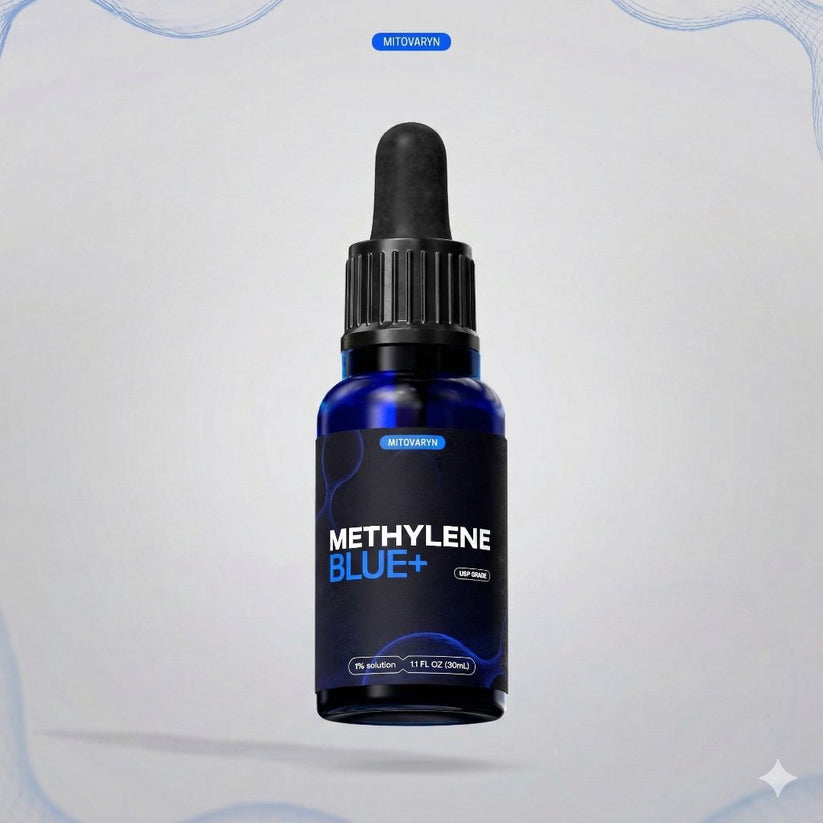
Review the current Mitovaryn Methylene Blue formulation and documentation. A well-characterized product is important, but it does not turn a mechanistic hypothesis into proven human life extension.
Medical disclaimer: This article is educational and is not medical advice, diagnosis, treatment or a longevity protocol. Methylene blue has clinically important contraindications and drug interactions. Consult a qualified healthcare professional who knows your medications and health history. Seek urgent care for possible serotonin syndrome, hemolysis, a serious allergic reaction or other severe symptoms.