
Mitovaryn Methylene Blue Learning Center
Methylene Blue for VO₂ Max: Evidence, Limits and Safety
Mitochondrial activity makes methylene blue scientifically interesting, but interest is not proof of a higher VO₂ max. This guide separates human performance evidence from animal and laboratory findings—and explains what athletes should measure instead of guessing.
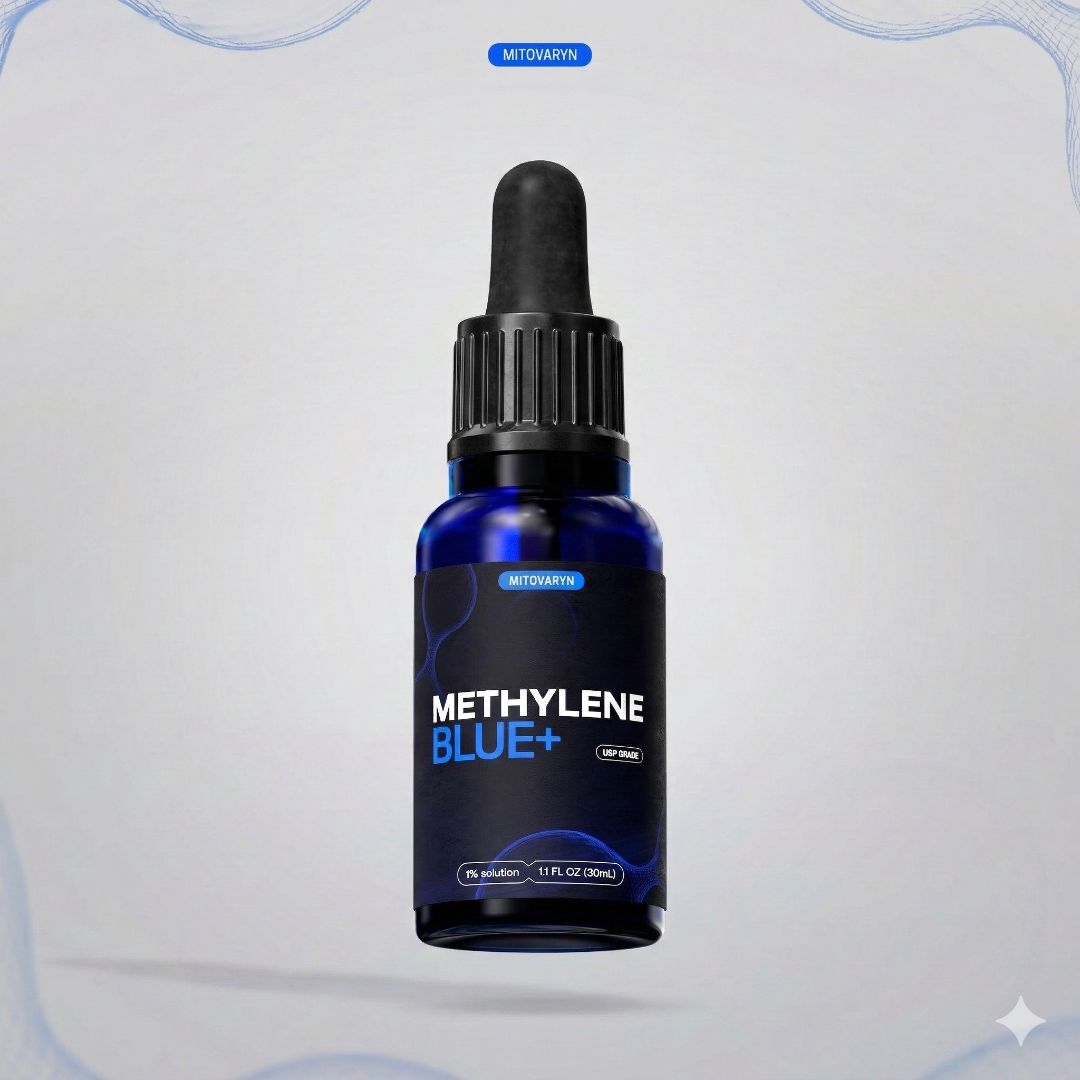
There is no convincing controlled human evidence that oral methylene blue increases VO₂ max. A 2025 rat study reported longer swim time to exhaustion after intranasal methylene blue, but it did not test oral use, humans or VO₂ max. Laboratory mitochondrial findings are mechanistically interesting and sometimes contradictory; they cannot be converted into an athletic-performance claim.
VO₂ max is an integrated whole-body measurement
VO₂ max is the highest rate at which the body can take in, transport and use oxygen during intense exercise. It is commonly expressed as liters per minute or relative to body mass in milliliters per kilogram per minute. Cardiorespiratory fitness reflects the coordinated work of the lungs, heart, blood, circulation and active muscle—not one mitochondrial pathway in isolation.
Bring oxygen in
Ventilation and gas exchange move oxygen from the environment into arterial blood.
Deliver oxygen
Cardiac output, hemoglobin and blood flow transport oxygen to working muscle.
Use oxygen
Muscle diffusion, mitochondria, enzymes and trained tissue extract oxygen and generate ATP.
Two related numbers are often confused. VO₂ peak is the highest value achieved on a particular test; VO₂ max implies a maximal physiological ceiling under suitable test conditions. Protocol choice and verification criteria affect the result.4
Methylene blue and VO₂ max: evidence at a glance
The strongest responsible conclusion is an evidence gap. Mechanistic findings can generate a hypothesis, but direct human testing is needed before claiming a VO₂-max benefit.
| Claim | Available evidence | Conclusion |
|---|---|---|
| Raises VO₂ max in humans | No controlled human oral trial demonstrating a higher directly measured VO₂ max was identified for this review. | Not established |
| Improves endurance | A small 2025 rat study reported a longer exhaustive-swim time after intranasal exposure. | Preclinical only Time to exhaustion is not VO₂ max, and rats are not athletes.1 |
| Improves mitochondrial respiration | Isolated rat-heart experiments found increased oxygen consumption with some substrates and substrate-dependent effects on hydrogen peroxide. | Mechanistic Not proof of better human exercise performance.2 |
| Makes oxygen use more efficient | Effects vary by model, concentration, redox state, substrate and light exposure. Other experiments reported uncoupling and impaired ATP generation. | Cannot be generalized3 |
| Works as a pre-workout | No validated human pre-exercise protocol with VO₂-max outcomes was identified. | No evidence-based protocol |
| Replaces aerobic training | VO₂ max reflects adaptations across multiple organ systems produced by training, recovery and health status. | No |
Evidence hierarchy: a mechanism can justify a study. An animal performance signal can justify a human trial. Neither establishes a consumer benefit until suitable controlled human research measures the actual outcome.
What the 2025 exhaustive-exercise study actually found
The most directly relevant study identified for this review used rats subjected to ten days of exhaustive exercise training. Methylene blue was administered intranasally after training sessions. The investigators focused primarily on neurological damage, behavior and brain mitochondrial morphology; they also reported improved swim time to exhaustion.1
| Study feature | What was done | Why it limits a VO₂-max claim |
|---|---|---|
| Species | Rats, with approximately six to seven animals contributing to reported group comparisons. | Animal physiology and experimental stress do not establish a human athletic response. |
| Route | Intranasal methylene blue after exercise sessions. | It does not test an oral consumer liquid or pre-workout timing. |
| Exercise model | Repeated exhaustive swimming intended to create neurological deficits. | This is not a normal endurance-training program or standardized human performance test. |
| Performance outcome | Time until exhaustion during swimming. | Time to exhaustion depends on motivation, protocol and other factors; it is not direct VO₂ max. |
| Primary biological outcomes | Brain pathology, behavior, synaptic proteins, glial activation and mitochondrial morphology. | Neuroprotection in a rat stress model is not evidence of increased human aerobic capacity. |
The study is useful for hypothesis generation. It does not answer whether oral methylene blue raises VO₂ max, improves race performance, changes lactate threshold or provides a favorable benefit–risk balance in trained people.
Why mitochondrial theory is compelling—and incomplete
Methylene blue can participate in redox reactions and interact with electron-transfer processes under particular experimental conditions. That is why it appears in discussions about cellular respiration. The leap from that chemistry to a higher VO₂ max, however, skips multiple required steps.
| Reasoning step | What is plausible | What still requires proof |
|---|---|---|
| Electron cycling | Methylene blue can accept and donate electrons depending on its redox state and environment. | That a specific oral exposure improves ATP production in exercising human muscle. |
| Oxygen consumption | Some isolated-tissue experiments show altered mitochondrial oxygen consumption. | That the change represents greater efficiency rather than uncoupling, stress or substrate-specific behavior. |
| Muscle performance | A favorable bioenergetic effect could theoretically influence fatigue. | Replicated improvements in human power, threshold, time trial or time-to-exhaustion outcomes. |
| Whole-body VO₂ max | Peripheral oxygen extraction is one determinant of maximal oxygen uptake. | A larger measured VO₂ max during standardized cardiopulmonary exercise testing. |
| Useful athlete outcome | Higher cardiorespiratory fitness is valuable. | Meaningful benefit that exceeds adverse effects, interactions and measurement noise. |
Mitochondria are not the whole test: an athlete may be limited by stroke volume, hemoglobin, pulmonary function, blood flow distribution, muscle diffusion, conditioning, illness, heat, altitude or test protocol. “Cellular energy” is not a diagnosis of the limiting factor.
See how methylene blue works and what its proposed benefits actually mean for the wider mechanism-to-outcome distinction.
More oxygen consumption does not always mean more efficiency
Efficiency asks how much useful ATP or external work is produced for a given energetic cost. Oxygen consumption can rise because more useful work is being performed—but it can also rise when oxidative phosphorylation becomes less tightly coupled.
In isolated rat-heart mitochondria, methylene blue increased oxygen consumption under tested substrate conditions, while its effects on hydrogen peroxide moved in opposite directions depending on the substrate.2 In a separate rat-liver model, investigators reported uncoupling, inhibited ATP production and metabolic disruption under their experimental conditions.3
| Observation | Possible interpretation | What it cannot prove alone |
|---|---|---|
| Higher mitochondrial O₂ consumption | Greater respiratory flux, higher energy demand or less efficient coupling. | More ATP, better economy or higher VO₂ max. |
| Lower oxidative marker | A favorable redox effect in that model and condition. | Net benefit across tissues, exposures and exercise states. |
| Longer animal time to exhaustion | A performance signal worth investigating. | Human race improvement or a change in measured VO₂ max. |
| Greater subjective energy | A personal perception affected by expectation and many confounders. | A physiological adaptation or safe exposure. |
The practical lesson: “uses more oxygen” and “uses oxygen more efficiently” are not synonyms. Performance claims require direct outcomes, not a preferred interpretation of one cellular measurement.
Measure VO₂ max rather than inferring it from a workout
A rigorous answer requires a pre-specified test, consistent conditions and enough time to distinguish biological change from normal variation. Laboratory cardiopulmonary exercise testing measures respiratory gases during graded exercise and remains the reference approach. Verification procedures can help confirm that a true maximum was reached.4
| Measurement | Strength | Limitation |
|---|---|---|
| Laboratory CPET | Direct breath-by-breath gas analysis with heart-rate and workload data. | Requires equipment, trained supervision and a suitable protocol. |
| Wearable VO₂ estimate | Convenient for repeated trend tracking under consistent conditions. | Individual error can be large. A meta-analysis found wide limits of agreement even when average bias was small for exercise-based algorithms.5 |
| Field test | Low-cost estimate using a standardized run, walk, cycle or shuttle protocol. | Depends on prediction equations, pacing, environment and motivation. |
| Race or time trial | Highly relevant to real performance. | Weather, terrain, tactics, fatigue, equipment and learning can change the result without changing VO₂ max. |
| How the workout felt | Useful for monitoring perceived exertion and recovery. | Cannot establish a VO₂-max change and is vulnerable to expectancy effects. |
A fair before-and-after comparison
- Use the same test modality, protocol, equipment and calculation method.
- Standardize recent training, sleep, hydration, nutrition, caffeine, temperature and altitude as far as practical.
- Avoid treating one wearable update as proof; look for a sustained trend or repeat formal testing.
- Track threshold pace or power, heart rate, perceived exertion and performance alongside VO₂ max.
- Do not introduce a risky compound merely to run a personal experiment.
What reliably belongs in a VO₂-max plan
Cardiorespiratory fitness is built through an appropriate training stimulus plus recovery. The exact plan should match health status, baseline fitness, sport and injury history. People with symptoms or medical conditions may need supervised testing before vigorous exercise.
Aerobic volume
Consistent lower- to moderate-intensity work builds the capacity to tolerate and recover from training.
High-intensity intervals
Appropriately dosed work near severe-intensity domains can provide a strong aerobic stimulus.
Progressive overload
Volume or intensity should advance gradually enough to create adaptation without persistent breakdown.
Recovery
Sleep, fueling, hydration and easier sessions allow training adaptations to accumulate.
Health factors
Iron status, respiratory disease, cardiac limitations, infection and overtraining can suppress performance.
Repeatable testing
Consistent measurement shows whether the program is working better than feelings alone.
No compound replaces conditioning: even if future research finds an adjunctive effect, it would not substitute for the cardiovascular, blood-volume, capillary, enzyme and muscle adaptations produced by training.
Performance interest does not reduce methylene blue’s risks
Methylene blue is biologically active. Current U.S. prescribing information for the injectable drug carries a boxed warning for serious or fatal serotonin syndrome when used with serotonergic drugs and opioids. The interaction section also names bupropion, buspirone, clomipramine, mirtazapine, linezolid and dextromethorphan. Laboratory work identifies methylene blue as a potent reversible MAO-A inhibitor.67
| Risk | Why athletes should care | Responsible action |
|---|---|---|
| Serotonin syndrome | Agitation, confusion, fever, sweating, tremor, rigidity, jerking, diarrhea and seizures can become life-threatening. | Do not combine with antidepressants or other medicines without the treating prescriber or pharmacist. |
| G6PD deficiency | Prescription labeling contraindicates methylene blue because severe hemolysis and anemia can occur. | Do not self-use when status is known or uncertain; seek medical assessment. |
| Pregnancy or breastfeeding | Labeling warns of fetal harm and serious potential reactions during lactation. | Avoid self-directed use and obtain medical guidance. |
| Kidney or liver impairment | Exposure, clearance and monitoring needs can change. | Obtain individualized clinical review. |
| Dizziness, confusion or visual effects | Symptoms can make cycling, running near traffic, swimming or operating equipment unsafe. | Stop the hazardous activity and seek guidance; do not train through symptoms. |
| Heat and exertion | Exercise can make fever, sweating, fast heart rate or dehydration easier to misattribute. | Treat unexpected multi-system symptoms seriously, especially with interacting substances. |
Urgent symptoms: confusion or agitation with fever, heavy sweating, diarrhea, tremor, rigidity, jerking or seizures may indicate serotonin syndrome. Breathing difficulty, severe weakness, jaundice, swelling or hives also require urgent medical evaluation.
The injection label does not create an oral wellness protocol, but it identifies compound-level hazards that should not be ignored. Read the full methylene blue safety guide, how to use methylene blue responsibly and why online dosage charts need context.
Product quality and performance efficacy are separate questions
Never ingest aquarium, textile, industrial or laboratory methylene blue. For a product marketed for human oral use, verify identity, concentration, ingredients, lot linkage, storage and relevant contaminant testing. Yet even a complete certificate of analysis cannot show that the product raises VO₂ max.
| Quality evidence | What it may support | What it cannot support |
|---|---|---|
| Identity result | That the tested sample matches the named compound under the stated method. | A fitness or endurance benefit. |
| Assay or concentration | How much analyte was measured in the tested sample. | A safe or effective performance dose. |
| Specified contaminant panel | Whether named analytes met the reported limits. | Freedom from every contaminant or adverse effect. |
| Batch-linked COA | Traceability between a report and a specific production lot. | That every bottle or future batch is identical. |
| USP-grade claim | Conformance to stated specifications when complete testing is shown. | FDA approval for VO₂ max, athletic performance or wellness use. |
Use the Mitovaryn lab-results guide, methylene blue safety and purity and the quality checklist to evaluate product documentation without confusing purity with efficacy.
Frequently asked questions
Does methylene blue increase VO₂ max?
There is no convincing controlled human evidence that oral methylene blue increases directly measured VO₂ max. Mechanistic and animal findings can support further research, but they do not establish an athletic benefit.
What is VO₂ max?
VO₂ max is the highest rate at which the body can take in, deliver and use oxygen during intense exercise. It reflects the integrated function of the lungs, heart, blood, circulation and exercising muscles.
How is VO₂ max measured?
Laboratory cardiopulmonary exercise testing measures respiratory gases during graded treadmill or cycle exercise. Wearables and field tests estimate VO₂ max, but individual error can be substantial and consistent testing conditions matter.
Why are mitochondria discussed in relation to VO₂ max?
Mitochondria in active muscle use oxygen during oxidative phosphorylation, so peripheral oxygen use contributes to aerobic capacity. VO₂ max still depends on multiple delivery and utilization systems, not mitochondria alone.
Does increased mitochondrial oxygen consumption prove better fitness?
No. Higher oxygen consumption can reflect greater productive respiration, higher demand or less efficient coupling. ATP production, work output and whole-body performance must be measured directly.
What did the rat exercise study find?
A 2025 study reported longer exhaustive-swim time and neurological protection in rats given intranasal methylene blue after repeated exhaustive exercise. It did not test oral use, human athletes or VO₂ max.
Can methylene blue improve endurance?
That has not been established in controlled human performance trials. An animal time-to-exhaustion signal is hypothesis-generating and cannot determine race performance, lactate threshold or a safe consumer protocol.
Is methylene blue a stimulant or pre-workout?
Methylene blue is not a conventional caffeine-like stimulant, but it is pharmacologically active and can cause serious interactions and adverse effects. No evidence-based pre-workout protocol for raising VO₂ max has been established.
When should methylene blue be taken before exercise?
No validated human timing or dosing protocol exists for improving VO₂ max. Do not convert animal routes, injectable medical dosing or online anecdotes into a personal pre-workout regimen.
Can methylene blue be taken with antidepressants?
Methylene blue inhibits MAO-A and can cause serious or fatal serotonin syndrome with serotonergic drugs. Do not combine it with an antidepressant or change prescribed medication without the treating prescriber or pharmacist.
Can competitive athletes use methylene blue?
Athletes should verify current rules with their governing body and consider medication, health and contamination risks. Compliance with a prohibited list does not establish safety, efficacy or product purity.
What is the most reliable way to improve VO₂ max?
An individualized program combining appropriate aerobic volume, higher-intensity work, progressive overload and recovery is the foundation. People with symptoms or medical conditions should obtain clinical guidance before maximal testing or vigorous training.
Sources and evidence notes
- Peng G, et al. Intranasal methylene blue administration confers neuroprotection in rats subjected to exhaustive exercise training. Frontiers in Behavioral Neuroscience. 2025. Animal evidence only; not oral human use or VO₂ max.
- Duicu OM, et al. Methylene blue improves mitochondrial respiration and decreases oxidative stress in a substrate-dependent manner in diabetic rat hearts. Canadian Journal of Physiology and Pharmacology. 2017.
- Klosowski EM, et al. The photodynamic and direct actions of methylene blue on mitochondrial energy metabolism. Free Radical Biology and Medicine. 2020.
- Beltz NM, et al. Graded Exercise Testing Protocols for the Determination of VO₂max. Journal of Sports Medicine. 2016.
- Molina-Garcia P, et al. Validity of Estimating Maximal Oxygen Consumption by Consumer Wearables. Sports Medicine. 2022.
- DailyMed: Methylene Blue Injection prescribing information. Updated April 2026. Safety labeling—not an oral performance protocol.
- Ramsay RR, Dunford C, Gillman PK. Methylene blue and serotonin toxicity. British Journal of Pharmacology. 2007.
Evaluate the product and the evidence separately
Review Mitovaryn Methylene Blue specifications and available documentation. Product quality matters, but it does not turn a mitochondrial hypothesis into proven VO₂-max or endurance performance.
Medical disclaimer: This article is educational and is not medical advice, diagnosis, treatment or a performance protocol. Methylene blue has clinically important contraindications and drug interactions. Consult a qualified healthcare professional who knows your medications and health history. Seek urgent care for possible serotonin syndrome, hemolysis, severe allergic reaction or other serious symptoms.