Mitovaryn Methylene Blue Learning Center
Methylene Blue for Cognitive Support: Evidence, Limits and Safety
Methylene blue is being studied for effects on brain metabolism, attention and memory—but the human evidence for cognitive enhancement remains small and preliminary. Here is what researchers have observed, what mechanisms only suggest, and what responsible evaluation requires.
Methylene blue has a plausible neuroenergetic research rationale, but it is not an established cognitive enhancer. A randomized, double-blind study in 26 healthy adults reported changes in task-related brain activity and a 7% increase in correct responses during one memory-retrieval task after a single oral administration. That intriguing result does not establish durable benefits, everyday productivity, treatment of cognitive symptoms or an appropriate self-use protocol.
“Cognitive support” needs a measurable definition
Cognition is not one outcome. Attention, processing speed, working memory, delayed recall and executive function are different domains. A study can find an effect on one task without showing broad improvement in intelligence or daily functioning.
Subjective terms such as “clarity,” “focus” and “brain fog” are useful descriptions, but they are vulnerable to expectancy, sleep, caffeine withdrawal, stress, mood and normal day-to-day variation. Strong claims need a prespecified outcome, a comparator, adequate blinding, replication and evidence that the measured change matters outside the testing session.
| Cognitive domain | Example measure | Different question it cannot answer |
|---|---|---|
| Sustained attention | Accuracy or reaction time during a vigilance task. | Whether someone will be more productive over weeks. |
| Working memory | Holding and manipulating information briefly. | Long-term learning or dementia prevention. |
| Memory retrieval | Correct responses after previously encoded material. | General intelligence or durable everyday recall. |
| Brain activation | Task-related functional MRI signal. | Whether activation is beneficial or clinically meaningful by itself. |
| Perceived clarity | A self-report scale or diary. | Objective cognitive performance without testing. |
Better question: instead of asking whether methylene blue “boosts the brain,” ask which outcome, in which population, after which formulation and exposure, compared with what, for how long.
The cognitive evidence at a glance
The evidence base is uneven. Mechanistic and animal work creates hypotheses; it does not supply the missing large, replicated human trials. The most directly relevant controlled human experiment was small, acute and exploratory.
| Evidence layer | What it contributes | Main limitation | Responsible conclusion |
|---|---|---|---|
| Redox and mitochondrial research | Biological rationale involving electron transfer and cellular metabolism. | A mechanism does not predict a net cognitive benefit or safe consumer use. | Hypothesis generating. |
| Cell and animal studies | Controlled exploration of memory, metabolism and neural pathways. | Species, exposure, task and disease models may not translate to healthy humans. | Preclinical support, not clinical proof. |
| 2016 healthy-adult trial | Randomized, double-blind, placebo-controlled human data using fMRI and cognitive tasks. | Twenty-six participants, a single administration and short follow-up. | Promising signal requiring replication. |
| Disease-focused studies | Research in defined neurologic populations and specialized formulations. | Cannot be generalized to healthy users or retail oral drops. | Answer a different clinical question. |
| Testimonials | Descriptions of individual experience. | No control for placebo, selection, sleep, caffeine, co-use or reporting bias. | Not efficacy evidence. |
This hierarchy is important for every downstream topic, including memory enhancement, studying and brain fog.
What the small randomized human study actually found
A 2016 study enrolled 26 healthy adults aged 22 to 62 in a prospective, randomized, double-blind, placebo-controlled experiment. Researchers performed functional MRI during a psychomotor-vigilance task and a delayed match-to-sample memory task before and one hour after a single oral administration of methylene blue or placebo.1
| Study element | Reported detail | Interpretation |
|---|---|---|
| Population | 26 healthy adults, ages 22–62. | Too small to characterize diverse users or uncommon harms. |
| Design | Randomized, double-blind and placebo controlled. | Stronger than an uncontrolled before-and-after account. |
| Time frame | Testing before and one hour after one administration. | An acute experiment, not evidence of sustained daily benefit. |
| Attention finding | Increased fMRI response in bilateral insular cortex during vigilance testing. | A neural-correlate finding, not a broad productivity result. |
| Memory finding | Task-related fMRI changes and 7% more correct responses during memory retrieval. | A specific task signal that needs independent replication. |
| Not established | Long-term effects, ideal use, real-world functioning and broad population safety. | The study cannot support a routine cognitive protocol. |
Statistical significance and clinical importance are not identical. A 7% change in one retrieval task can justify more research, but it does not mean every user becomes 7% “smarter,” remembers 7% more in daily life or receives a durable benefit. The study also cannot establish an onset timeline for retail products used repeatedly.
Do not turn the experiment into a dosing recipe. A research exposure chosen for one tightly controlled study is not a personalized recommendation, and consumer products may differ in formulation, concentration and intended use.
A plausible mechanism is not a proven outcome
Methylene blue is a redox-active molecule: it can cycle between oxidized and reduced forms. Laboratory and preclinical literature has examined whether this behavior can affect mitochondrial electron transfer, oxygen use and cellular energy metabolism. These ideas help explain why researchers measure brain activation and memory tasks—but they do not prove better cognition in everyday users.
Electron transfer
Experimental work proposes that methylene blue may participate in redox cycling under particular conditions. The net effect depends on concentration, cellular context and competing reactions.
ATP and metabolism
Neurons require substantial energy, so mitochondrial effects are biologically relevant. Yet an assumed increase in ATP is not equivalent to a demonstrated improvement in attention or memory.
Oxidative balance
Redox-active compounds are not simply “antioxidants.” Effects can change with exposure and conditions, which is one reason linear more-is-better claims are unreliable.
Explore these mechanisms separately in how methylene blue works in mitochondria, ATP production and oxidative-stress research.
Inference boundary: “may influence a pathway” is not the same as “improves a symptom,” and neither establishes prevention or treatment of a disease.
Common cognitive claims, graded by the evidence
The right wording should reflect the weakest link between molecule, mechanism, study design, formulation and promised outcome.
| Claim | Evidence status | More accurate framing |
|---|---|---|
| “Improves memory” | One small acute study reported a task-specific retrieval result. | Preliminary human signal; durability and real-world relevance are unestablished. |
| “Improves focus” | The trial reported attention-task fMRI changes, not a broad work-performance outcome. | Studied in sustained-attention paradigms; routine benefit is not established. |
| “Clears brain fog” | Brain fog is nonspecific and was not validated as a treated condition by the small trial. | Persistent symptoms deserve cause-focused assessment. |
| “Raises intelligence” | Unsupported. | No evidence that methylene blue increases general intelligence. |
| “Works without stimulation” | Not established as a universal subjective experience or safety advantage. | Its pharmacology differs from caffeine, but different does not mean inert. |
| “Prevents cognitive aging” | Not demonstrated by long-term prevention trials in healthy adults. | Mechanistic interest should not be converted into an anti-aging promise. |
| “Treats ADHD or depression” | Not an approved indication and not supported by this cognition experiment. | Do not replace diagnosis or established treatment with self-use. |
| “More consistency means more benefit” | Unsupported without repeated-use trials. | Frequency, cumulative exposure and long-term outcomes remain separate questions. |
Condition-specific pages on ADHD, depression and anxiety should be read as evidence audits—not treatment recommendations.
Start with the reason cognition feels different
Difficulty concentrating, memory complaints and mental fatigue are symptoms, not diagnoses. Sleep loss, sleep apnea, stress, depression, anxiety, medication effects, substance use, anemia, thyroid disease, infection, nutritional problems, pain and other conditions can overlap. A supplement-first response can delay the more useful question: what changed, and why?
| Pattern | Questions worth documenting | Appropriate next step |
|---|---|---|
| Sudden confusion or neurologic change | Exact onset, speech, weakness, severe headache, seizure, injury or exposure. | Seek emergency assessment rather than trying a cognitive product. |
| New or worsening brain fog | Illness, sleep, medicines, supplements, mood, pain and substance changes. | Arrange clinical review when persistent, unexplained or functionally significant. |
| Study or work fatigue | Sleep duration, workload, breaks, meals, hydration and caffeine timing. | Correct reversible workload and recovery factors first. |
| Memory concern | Examples, progression, safety errors, collateral observations and daily impact. | Use validated assessment rather than judging from a single good or bad day. |
| Medication-linked change | New drugs, dose changes, OTC products and recently stopped agents. | Ask a prescriber or pharmacist; do not change prescriptions alone. |
Urgent distinction: sudden confusion, one-sided weakness, facial droop, speech difficulty, severe sudden headache, seizure, fainting or major behavior change can signal an emergency. Do not wait for a supplement response.
Methylene blue is not simply “caffeine without the crash”
Caffeine and methylene blue have different pharmacology and evidence bases. That makes them unsuitable for a winner-versus-loser comparison. Caffeine has extensive human research on alertness and performance; methylene blue has limited direct human cognitive data and clinically important interaction risks.
| Feature | Caffeine | Methylene blue |
|---|---|---|
| Primary framing | Adenosine-receptor antagonist with established stimulant effects. | Redox-active drug studied across medical and experimental contexts. |
| Healthy-human cognition evidence | Large and varied literature on alertness and performance. | A small acute randomized study plus indirect and preclinical evidence. |
| Subjective response | Can increase alertness; can also cause jitters or disturb sleep. | No reliable universal feeling, onset or “smooth focus” profile is established. |
| Tolerance and withdrawal | Well-characterized with regular use. | Not established as an equivalent consumer-use pattern. |
| Major safety distinction | Dose, sleep, cardiovascular symptoms and individual sensitivity matter. | Serotonergic interactions, G6PD deficiency, pregnancy and other factors require screening. |
| Responsible conclusion | Not harmless, but extensively studied. | Not a proven drop-in replacement or established nootropic. |
See the deeper comparisons in methylene blue versus caffeine, the caffeine evidence guide and methylene blue versus other nootropics.
Product quality is necessary—but does not prove cognition
If a person is evaluating a methylene-blue product, the bottle should be reviewed independently of the benefit claim. Color, price, testimonials and a “99% pure” headline cannot establish finished-liquid identity, concentration, contaminants or stability.
| Quality check | Evidence to look for | What it cannot establish |
|---|---|---|
| Human-use labeling | Explicit intended route, ingredients, warnings and responsible party. | That the intended use is FDA approved. |
| Identity | Suitable test against a qualified reference standard. | Memory, attention or brain-fog benefit. |
| Concentration | Finished-product assay supporting the labeled mg/mL. | A personalized dose or standardized drop volume. |
| Purity and contaminants | Risk-based methods, specifications, numerical results and reporting limits. | Absence of anything the methods did not test. |
| Lot and stability | Batch match, dates, marketed packaging and storage-supported shelf life. | Medication compatibility or long-term cognitive safety. |
Use the detailed guides to choosing high-quality methylene blue, safety and purity, Mitholyne lab results and reading lab tests.
Cognitive interest does not override medical safety
Current U.S. prescription labeling is for intravenous treatment of acquired methemoglobinemia—not cognitive enhancement. It carries a boxed warning for serious or fatal serotonin syndrome with serotonergic drugs and opioids and identifies additional risks involving G6PD deficiency, pregnancy, hypersensitivity, renal impairment and other clinical factors.2
| Screen | Why it matters | Action |
|---|---|---|
| Antidepressants and serotonergic agents | Methylene blue inhibits monoamine oxidase A and can contribute to serotonin syndrome. | Have a prescriber or pharmacist review all current and recently stopped products. |
| Opioids and dextromethorphan | Current labeling identifies serious CNS-reaction risk with interacting agents. | Include pain medicines and OTC cough or cold products in the review. |
| G6PD deficiency | Severe hemolysis and ineffective treatment can occur. | Do not guess status; ask a clinician whether testing or avoidance is indicated. |
| Pregnancy or breastfeeding | Prescription labeling warns of fetal harm; infant exposure needs assessment. | Seek specialist guidance rather than self-experimenting. |
| Kidney, liver or blood conditions | Health status can affect exposure, monitoring and risk. | Review the conditions and relevant tests with a clinician. |
| Driving or hazardous work | Labeling reports confusion, dizziness and visual disturbances after medical use. | Do not assume a cognitive claim guarantees safer performance. |
Never stop an antidepressant or another prescribed medicine to create a self-directed washout. The prescriber must weigh half-life, withdrawal, relapse and the reason for treatment.
Continue with drug interactions, side effects and the dosage evidence guide.
How to evaluate a cognitive-support claim online
- Name the outcome. “Focus” must become an attention measure, a validated self-report or a defined real-world endpoint.
- Find the population. Healthy adults, people with a diagnosed condition, animals and cells are not interchangeable.
- Match the intervention. Confirm chemical form, formulation, route, concentration, exposure and frequency.
- Inspect the comparator. Placebo-controlled evidence answers more than a testimonial or uncontrolled before-and-after story.
- Check time. One hour after one administration cannot establish months of effectiveness or safety.
- Separate scan from function. A brain-imaging change is not automatically an improvement in daily cognition.
- Look for replication. One small study can produce a credible signal without settling the question.
- Read harms with benefits. A cognitive article that omits medication interactions is incomplete.
Marketing translation: phrases such as “supports cellular energy” may describe a proposed mechanism. They should not be read as proof of better memory, productivity, intelligence or protection from cognitive decline.
The myths and misconceptions guide, benefits review and uses guide apply this framework across other claims.
Methylene blue for cognitive support: FAQ
Does methylene blue improve cognition?
A small randomized study found task-related brain-activity changes and improved performance on one memory-retrieval measure, but broad, durable cognitive enhancement is not established.
What human research supports methylene blue for cognition?
The most directly relevant controlled study enrolled 26 healthy adults and measured acute attention, memory and functional-MRI outcomes after one administration.
Is methylene blue an established nootropic?
No. It is discussed as a nootropic, but limited direct human evidence does not establish routine effectiveness, long-term safety or a standard cognitive-use protocol.
How quickly does methylene blue improve focus?
No reliable consumer onset has been established. One study tested participants after one hour, which does not prove a universal experience or timeline.
Can methylene blue replace caffeine?
It is not a proven drop-in replacement. The compounds have different pharmacology, evidence, subjective effects and safety considerations.
Does methylene blue improve memory?
One small acute study reported a 7% increase in correct responses during a specific retrieval task. Replication and evidence of lasting everyday benefit are needed.
Does methylene blue treat brain fog?
That has not been established. Brain fog has many possible causes, so persistent, new or functionally significant symptoms deserve cause-focused assessment.
Is methylene blue FDA approved for cognitive support?
No. Current U.S. prescription labeling is for intravenous treatment of acquired methemoglobinemia, not cognitive enhancement or routine oral wellness use.
Which medicines can interact with methylene blue?
Serotonergic drugs, certain opioids and dextromethorphan are important concerns. A pharmacist or prescriber should review all medicines and supplements.
Why does G6PD deficiency matter?
Methylene blue may cause severe hemolysis and ineffective treatment in people with G6PD deficiency, making clinician-led assessment important.
Does high purity prove a cognitive benefit?
No. Quality testing can characterize selected product attributes; it cannot demonstrate attention, memory, mood or productivity outcomes.
How can I judge a methylene-blue cognitive claim?
Check the outcome, population, formulation, route, comparator, duration, sample size, replication, safety reporting and whether the conclusion exceeds the study.
Research and medical sources
- Rodriguez P, et al. Multimodal Randomized Functional MR Imaging of the Effects of Methylene Blue in the Human Brain. Radiology. 2016.
- DailyMed: Methylene Blue Injection prescribing information.
- U.S. FDA: Methylene blue and serotonergic psychiatric medications.
- U.S. Pharmacopeia: Overview of USP monographs.
Review the product without outrunning the evidence
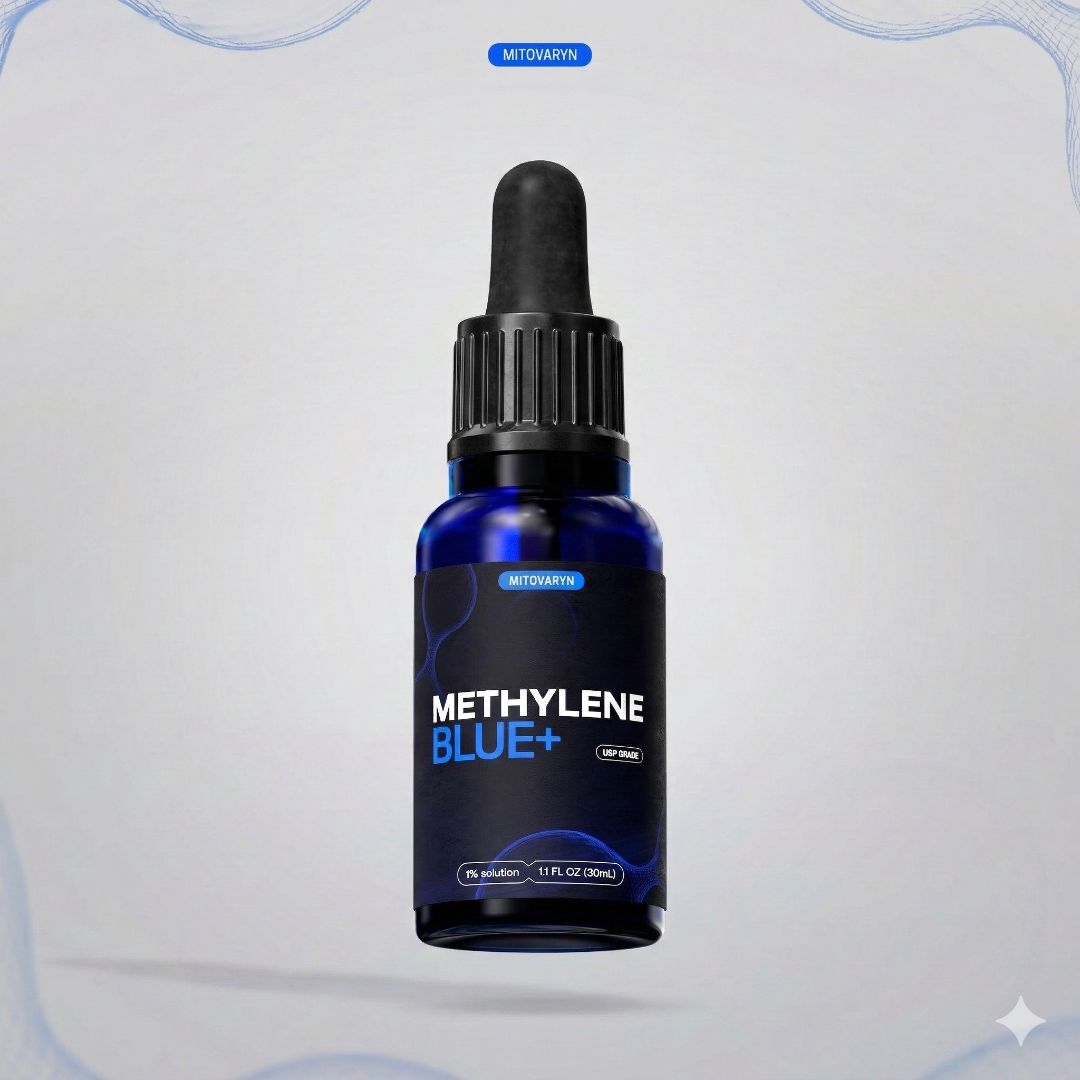
Explore Mitovaryn Methylene Blue’s exact formula, concentration and available documentation. Product transparency supports an informed quality review; it does not guarantee cognition, establish a personal dose or replace medication screening.