Mitovaryn Methylene Blue Learning Center
Methylene Blue Dosage Guide: Concentration, Measurement and Safety
A responsible dosage guide must separate three questions: how concentrated a solution is, how much liquid is measured, and whether a dose is appropriate for a particular person. Only the first two are arithmetic; the third requires clinical context.
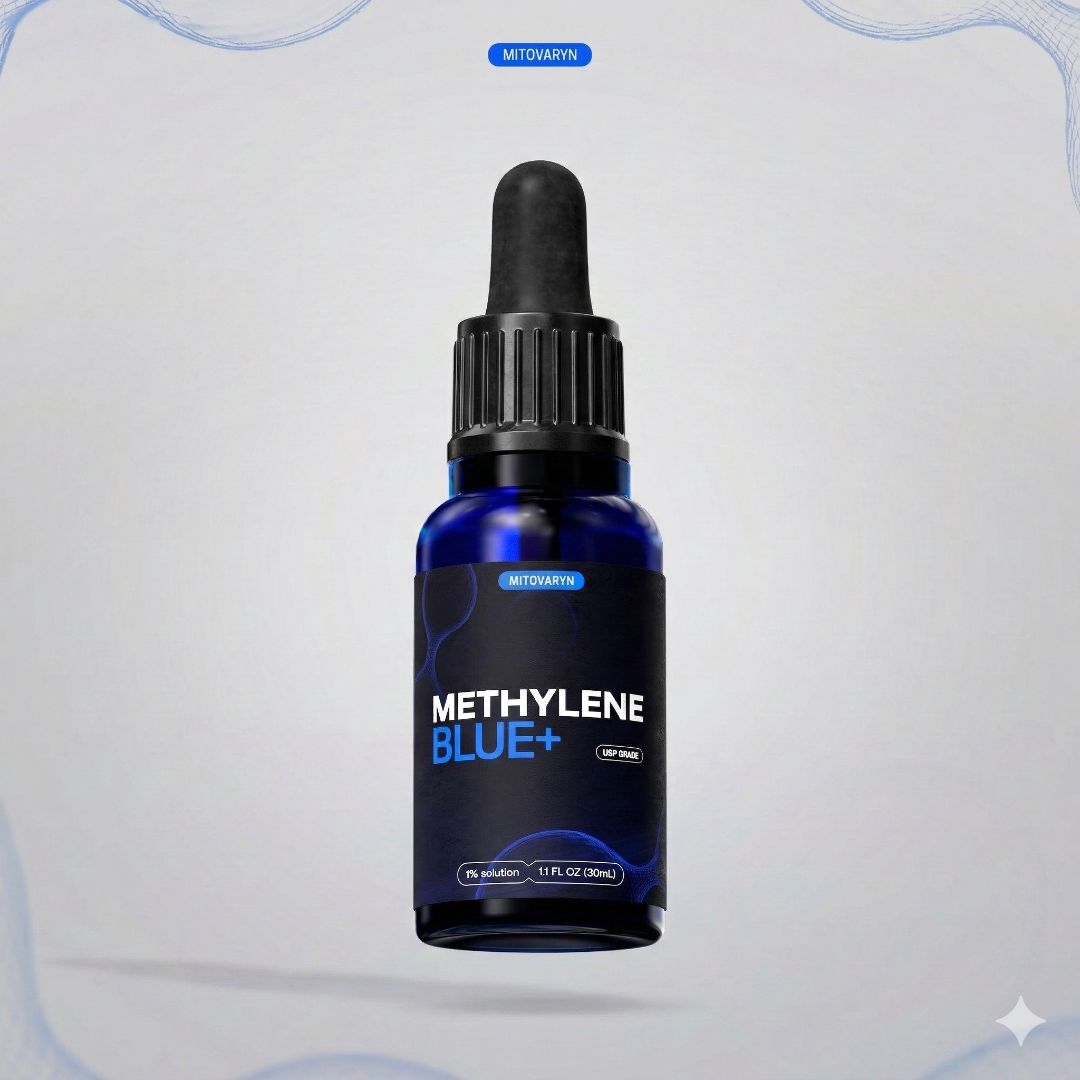
There is no universally established oral methylene-blue dose for focus, energy, studying, longevity or general wellness. A label can tell you concentration, and a calibrated device can tell you volume. Together they determine milligrams. They do not determine whether that amount is safe, effective or appropriate. Current U.S. prescribing information covers intravenous treatment of acquired methemoglobinemia—not a consumer oral routine.
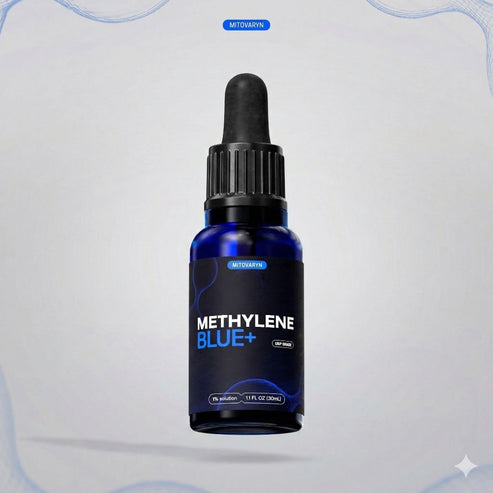
Start with the concentration, not the drop count
Review Mitovaryn’s labeled formula and product-specific documentation. Testing and clear labeling help characterize the bottle; they do not create a clinically validated wellness dose or establish medication compatibility.
Dosage is not one number
Online discussions often use “dose,” “drop,” “milliliter,” “percent” and “milligram” as though they mean the same thing. They do not. A dose decision has three distinct layers, and mixing them is a common source of error.
| Layer | Question it answers | What it cannot answer |
|---|---|---|
| Concentration | How many milligrams are present in each milliliter? | Whether a particular amount is appropriate. |
| Measured volume | How many milliliters were drawn or dispensed? | Milligrams unless concentration is known. |
| Clinical dose selection | Which exposure, if any, fits the person, purpose and risk profile? | This cannot be determined from arithmetic or a generic webpage. |
The key equation is simple: milligrams = milliliters × milligrams per milliliter. The difficult question is choosing the milligrams. This article explains the math but does not select an oral dose.
A product’s percent, mg/mL statement and measuring device should agree. If they do not—or if the concentration basis is unclear—pause rather than estimate.
How methylene-blue concentration works
When a liquid concentration is stated as percent weight/volume, the percentage represents grams of solute per 100 mL of solution. Because one gram equals 1,000 mg, a 1% w/v solution contains 1,000 mg per 100 mL, or 10 mg/mL. A 0.1% w/v solution contains 1 mg/mL.
| Label concentration | Weight/volume meaning | Equivalent concentration | Important qualification |
|---|---|---|---|
| 0.1% w/v | 0.1 g per 100 mL. | 1 mg/mL | Arithmetic only; not a recommended strength or dose. |
| 0.5% w/v | 0.5 g per 100 mL. | 5 mg/mL | Verify that the label actually uses w/v. |
| 1% w/v | 1 g per 100 mL. | 10 mg/mL | Ten times as concentrated as 0.1% w/v. |
| 2% w/v | 2 g per 100 mL. | 20 mg/mL | Do not assume products with similar bottles share concentration. |
The shortcut for a w/v percentage is: percent × 10 = mg/mL. This shortcut is valid only when the percent is truly stated as weight per volume. Percent weight/weight, unusual solvents or ambiguous labeling require different interpretation.
A tenfold error is easy to make
Confusing 0.1% with 1% changes the milligrams in the same liquid volume by a factor of ten. Comparing “five drops” from two bottles is meaningless unless both concentration and actual drop volume are known.
Convert measured milliliters to milligrams
The chart below is a concentration reference, not a dosing recommendation. It shows the amount of methylene blue mathematically present in selected volumes when the label concentration is accurate.
| Measured volume | At 0.1% w/v (1 mg/mL) | At 0.5% w/v (5 mg/mL) | At 1% w/v (10 mg/mL) |
|---|---|---|---|
| 0.05 mL | 0.05 mg | 0.25 mg | 0.5 mg |
| 0.10 mL | 0.1 mg | 0.5 mg | 1 mg |
| 0.25 mL | 0.25 mg | 1.25 mg | 2.5 mg |
| 0.50 mL | 0.5 mg | 2.5 mg | 5 mg |
| 0.75 mL | 0.75 mg | 3.75 mg | 7.5 mg |
| 1.00 mL | 1 mg | 5 mg | 10 mg |
To work backward, use milliliters = milligrams ÷ mg/mL. The “milligrams” in that equation must come from an appropriate professional decision or validated instruction—not from choosing a row that looks small.
Example of arithmetic only: 0.25 mL of a verified 1% w/v solution contains 2.5 mg because 0.25 mL × 10 mg/mL = 2.5 mg. This demonstrates conversion; it is not advice to take that amount.
Why drop counts are estimates, not units
A drop is not a standardized medical unit. Drop size changes with the dropper tip, angle, squeeze force, liquid properties, temperature and technique. “Twenty drops per milliliter” is a common working estimate, but it must not be treated as universal calibration.
| If 20 drops = 1 mL | Estimated volume | At 0.1% w/v | At 1% w/v |
|---|---|---|---|
| 1 drop | 0.05 mL | 0.05 mg | 0.5 mg |
| 2 drops | 0.10 mL | 0.1 mg | 1 mg |
| 5 drops | 0.25 mL | 0.25 mg | 2.5 mg |
| 10 drops | 0.50 mL | 0.5 mg | 5 mg |
| 20 drops | 1.00 mL | 1 mg | 10 mg |
Every value in this drop table assumes exactly 20 drops per mL. If the actual dropper delivers 15 or 30 drops per mL, the milligrams per drop change. Use the manufacturer’s verified calibration or a marked oral syringe/pipette when precision matters.
Do not count drops from a social-media video, photograph or another brand’s bottle. Read how methylene-blue drop counts work for a focused explanation.
Read the bottle and certificate of analysis together
A useful label should identify the compound, concentration, amount per stated unit, ingredients, lot or batch, storage information and intended product context. A certificate of analysis can add evidence about a submitted sample, but its scope depends on the method and analytes actually reported.
| Item to verify | What it tells you | What it does not prove |
|---|---|---|
| mg/mL statement | Converts measured liquid volume into milligrams. | That the stated amount is appropriate for you. |
| Percent and basis | Whether the solution is 0.1%, 1% or another concentration and whether w/v applies. | Drop volume or clinical benefit. |
| Lot identifier | Whether a report can be connected to a batch. | That every bottle was individually tested. |
| Identity and assay | What the method detected and how much in the sample. | Absorption, effectiveness or medication compatibility. |
| Contaminant panel | Results for the contaminants specifically tested. | Absence of every possible impurity. |
| Dropper calibration | Estimated drops per known volume for that delivery system. | Every drop will be identical. |
A “lab tested” badge without a matching report, method, result, unit and batch context is not enough to audit concentration. See how to read methylene-blue lab tests and Mitovaryn’s available lab results.
Why a published research dose is not a consumer protocol
Research doses answer a study’s question under a specific protocol. Translating one requires the same compound, formulation, route, population, timing, comparator and outcome. Even then, one experiment may establish only an acute biological effect—not repeated-use benefit or safety.
An oral pharmacokinetic study found high absolute bioavailability for a particular aqueous methylene-blue formulation in healthy volunteers.2 That result describes absorption under those conditions. It does not validate every commercial product, wellness goal or dose.
A randomized imaging study in 26 healthy adults assessed one oral exposure during vigilance and short-term-memory tasks and reported task-related brain changes plus a memory-retrieval difference.3 It did not establish a daily focus dose, ADHD treatment, long-term cognitive benefit or a general “brain energy” regimen.
| Translation question | Why it matters | Unsafe shortcut |
|---|---|---|
| Was the route the same? | Oral, intravenous and local exposure have different kinetics and contexts. | Converting an IV mg/kg order into oral drops. |
| Was the formulation the same? | Solvent, concentration and product quality may affect exposure. | Assuming all blue solutions are interchangeable. |
| Was the population the same? | Healthy volunteers do not establish treatment for a disease or condition. | Using a memory study as a dose for ADHD or depression. |
| Was duration the same? | A single exposure does not establish repeated-use safety. | Turning an acute experiment into a daily routine. |
| Was the outcome clinical? | Imaging or biomarkers may not translate to meaningful benefit. | Treating mechanism as proof of effectiveness. |
The approved IV dose is medical context—not an oral guide
Current U.S. prescribing information identifies methylene blue injection for acquired methemoglobinemia. The labeled regimen uses weight-based intravenous administration with clinical monitoring and specific provisions for repeat treatment and renal impairment.1
Do not convert the hospital label into a wellness routine. The indication, route, formulation, dose scale, monitoring and risk-benefit calculation are different. A clinician treating methemoglobinemia is not following an oral nootropic protocol.
The label also demonstrates why “methylene blue dosage” cannot be separated from indication. A dose exists inside a clinical decision: what is being treated, why this route is appropriate, which risks apply, how response is measured and what happens if treatment fails.
Online calculators that multiply body weight by a research or IV number can create false precision. Body weight does not resolve indication, contraindications, formulation, medication interactions or uncertainty about oral wellness use.
Individual factors change risk—not just quantity
Generic advice often says to adjust for body size, sensitivity or goal. Those variables do not create a validated algorithm. A smaller amount can still be inappropriate when a contraindication or drug interaction is present.
- Medication list: prescription, nonprescription, recreational and supplement ingredients all matter.
- G6PD status: deficiency creates a risk of severe hemolysis.
- Pregnancy and breastfeeding: current labeling contains important reproductive and lactation cautions.
- Kidney and liver function: exposure and medical risk may differ.
- Age and diagnosis: healthy-adult research cannot be transferred automatically to children or clinical populations.
- Purpose: a vague goal such as “energy” does not define a measurable benefit or acceptable risk.
“Start low” is not a substitute for screening. It may reduce exposure, but it does not prove safety, eliminate MAO-A activity or make an incompatible medication combination acceptable.
Timing and frequency claims are not validated dosing rules
Time of day, meal timing and frequency can change exposure or experience, but no general oral wellness schedule has been established. Advice to use methylene blue every morning, before demanding work, intermittently or in “cycles” is not a substitute for evidence.
| Common advice | What is uncertain | Better interpretation |
|---|---|---|
| “Always take it in the morning” | A universal cognitive timing strategy has not been validated. | Timing should follow the specific clinical or professional plan. |
| “Take it before studying or training” | No general performance protocol establishes benefit or safety. | Anecdotal timing does not prove a performance effect. |
| “Food makes it gentler” | Meal effects may depend on formulation and have not created a universal rule. | Use product- and clinician-specific instructions. |
| “Daily use is required” | Long-term oral wellness benefit and safety are not established. | Frequency needs its own evidence; it is not implied by one dose. |
| “Cycling prevents tolerance” | No validated cycling schedule proves sustained benefit or risk reduction. | A break schedule cannot repair an unsupported regimen. |
Interactions and contraindications come before calculation
Methylene blue is a potent reversible inhibitor of monoamine oxidase A in laboratory research.4 Current prescribing information carries a boxed warning for serious or fatal serotonin syndrome with serotonergic drugs and opioids; it also identifies dextromethorphan as a relevant interacting drug.1
| Context | Why it matters | Responsible next step |
|---|---|---|
| SSRI, SNRI, MAOI or other serotonergic drug | Serotonin syndrome can be serious or fatal. | Have the exact regimen reviewed by a prescriber or pharmacist. |
| Opioid or dextromethorphan | Prescription and cough products may increase serotonin risk. | Review all active ingredients, not only brand names. |
| G6PD deficiency | Severe hemolysis and anemia may occur. | Do not self-dose; obtain medical guidance. |
| Pregnancy or breastfeeding | Fetal and infant exposure require specific risk assessment. | Discuss with the relevant medical professional. |
| Kidney or liver impairment | Exposure, clearance and monitoring may differ. | Seek clinician and pharmacist review. |
| Unknown or ambiguous product | Concentration, identity or contaminants may be uncertain. | Do not estimate from color, bottle size or another brand. |
Seek urgent medical help for agitation or confusion with fever, sweating, diarrhea, tremor, muscle rigidity, jerking movements, poor coordination or seizures—especially after combining methylene blue with a serotonergic medicine, opioid or dextromethorphan.
Read the full drug-interaction guide and side-effects guide. If an incorrect amount was taken or the product is uncertain, contact local poison-control or emergency services rather than using an online calculator to decide whether it is safe.
Common dosage errors—and how to prevent them
- Confusing percent with mg/mL: write the conversion down before measuring.
- Comparing drops across bottles: use a calibrated volume, not an assumed drop count.
- Moving a decimal: confirm whether the label says 0.1%, 0.5%, 1% or another value.
- Copying a study: check route, formulation, population, duration and endpoint.
- Using body weight as permission: weight-based math does not screen interactions or establish an indication.
- Escalating because no effect is felt: subjective sensation is not a safe titration marker.
- Ignoring other products: cough medicine, pain medicine, antidepressants and supplements may change risk.
- Equating purity with suitability: a well-characterized product can still be inappropriate for a person.
A safer sequence is: verify identity and concentration → review contraindications and every active medication → define the intended outcome → obtain appropriate professional guidance → use a calibrated volume only if a dose has been selected responsibly.
For administration and handling context, continue to how to take methylene-blue drops orally, how to use methylene blue and the full safety guide.
Methylene blue dosage: FAQ
What is a standard oral methylene-blue dose?
No universal oral dose is established for focus, energy, studying, longevity or general wellness. Dose selection requires purpose, product and individual risk context.
What does a 1% methylene-blue solution mean?
When the percentage is weight/volume, 1% means 1 gram per 100 mL, which equals 10 mg/mL. This is concentration math, not a recommended dose.
What does a 0.1% methylene-blue solution mean?
When stated as weight/volume, 0.1% equals 1 mg/mL. It is one-tenth the concentration of a 1% w/v solution.
How do I calculate milligrams from milliliters?
Multiply measured mL by the labeled mg/mL. For example, 0.25 mL × 10 mg/mL equals 2.5 mg; the equation does not determine whether that amount is appropriate.
How many drops are in one milliliter?
Twenty drops per mL is a common estimate, not a universal standard. The actual number depends on the dropper, liquid and technique.
How many milligrams are in one drop of 1% solution?
If—and only if—the dropper delivers exactly 20 drops/mL, one drop of 1% w/v solution estimates to 0.5 mg. Verify calibration rather than assuming.
Is more methylene blue more effective?
No. Higher exposure does not guarantee more benefit and may increase adverse effects. Subjective intensity is not a reliable marker of effectiveness.
Can I copy the dose used in a study?
Not responsibly without clinical context. Route, formulation, population, duration and outcome may not match your product or purpose.
Is there an approved oral dose for focus or energy?
No. Current U.S. prescribing information is for intravenous treatment of acquired methemoglobinemia, not oral cognitive or wellness use.
Can methylene blue be taken with antidepressants?
Methylene blue can inhibit MAO-A, and labeling warns of serious or fatal serotonin syndrome with serotonergic drugs. Ask a prescriber or pharmacist.
Who should not self-dose methylene blue?
Self-dosing is especially unsafe with interacting medicines, G6PD deficiency, pregnancy, breastfeeding, kidney or liver disease, or an uncertain product.
What is the most accurate way to measure the liquid?
A calibrated oral syringe or marked pipette measures volume more reliably than counting drops. Accurate measurement still does not select a safe dose.
Primary, pharmacokinetic and regulatory sources
- U.S. National Library of Medicine. Methylene Blue Injection prescribing information. DailyMed; revised March 2026.
- Walter-Sack I, et al. High absolute bioavailability of methylene blue given as an aqueous oral formulation. Eur J Clin Pharmacol. 2009.
- Rodriguez P, et al. Multimodal randomized functional MR imaging of the effects of methylene blue in the human brain. Radiology. 2016.
- Ramsay RR, et al. Methylene blue and serotonin toxicity: inhibition of monoamine oxidase A. Br J Pharmacol. 2007.
- Klosowski EM, et al. The photodynamic and direct actions of methylene blue on mitochondrial energy metabolism. Free Radic Biol Med. 2020.
Review method: this guide separates unit conversion from dose selection and prioritizes current prescribing information, human pharmacokinetics, controlled human research and mechanistic safety evidence. Numerical tables are mathematical references only.
Review the concentration before considering the drops
See Mitovaryn Methylene Blue specifications and available documentation. Clear concentration and product testing support informed review, but they do not establish a universal dose, clinical benefit or medication compatibility.