
Mitovaryn Quality Learning Center
Lab Tests & Quality Assurance: How to Verify the Evidence
A laboratory claim is only as useful as the report behind it. Learn how to match a certificate of analysis to a product lot, interpret methods and units, and separate verified quality data from conclusions a COA cannot support.
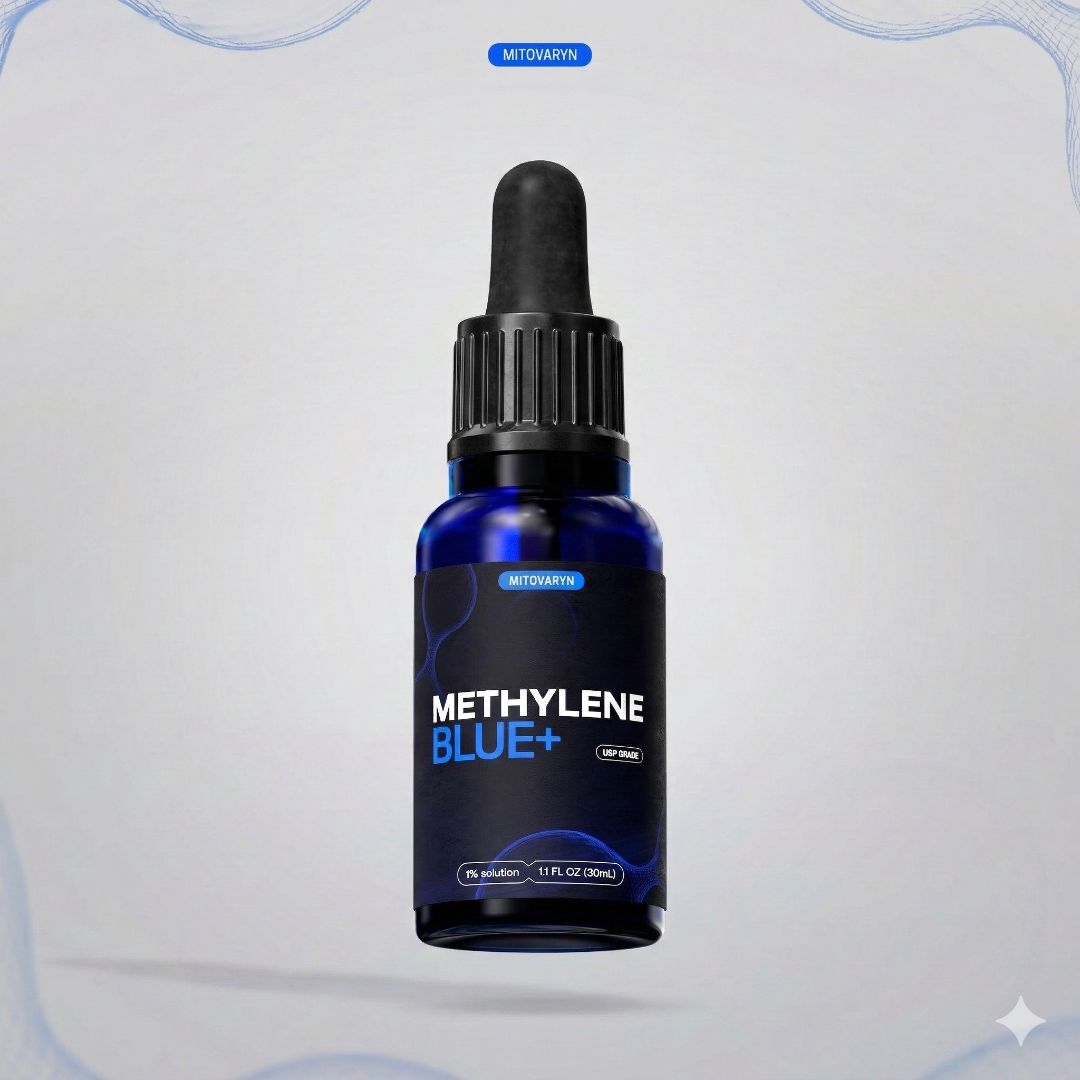
A credible COA identifies the tested sample, lot, laboratory, method, specification, actual result, units and date. “Third-party tested,” “USP grade,” “99.9% pure” or “heavy-metal free” should never stand alone. The document must show exactly what was tested—and its limits.
Find the documentation that matches the product
Methylene blue and a peptide product do not require identical analytical questions. Start with the exact product, then look for documentation relevant to its identity, composition and plausible contaminants.
Compound identity, assay and impurities
Look for a lot-linked report with a suitable identity or assay method, actual numerical results and defined limits. A broad “tested” badge cannot replace the document.
Sequence, purity, quantity and finished product
Peptide identity and chromatographic purity answer different questions. An oral capsule also needs evidence relevant to the finished formulation—not only a raw-material chromatogram.
Transparency rule: if the report for the current lot is not available online, request it before purchase. The useful document is the one that can be matched to the bottle—not a generic example or an unrelated batch.
What a useful certificate of analysis should show
A COA is a summary of results for a defined sample. Its credibility comes from traceability and technical detail, not the design of the PDF.
| COA field | Why it matters | What to check |
|---|---|---|
| Product and sample name | Defines what the laboratory says it received. | Exact compound, formulation and sample description—not only a marketing name. |
| Lot or batch number | Creates the link between report and inventory. | It should match the identifier printed on the bottle or package. |
| Laboratory identity | Allows the issuer and credentials to be checked. | Legal name, address, report contact and accreditation details where claimed. |
| Dates | Show when the sample was received, tested and reported. | A plausible chronology tied to the product lot. |
| Method | Explains how the analyte or property was measured. | Method name or identifier, not just “lab tested.” |
| Specification | States the acceptance criterion chosen before interpreting the result. | A numerical limit or clear qualitative requirement. |
| Actual result and units | Shows what was measured. | A number or defined outcome with units—not only “PASS.” |
| Authorization | Indicates the report was reviewed and issued. | Signature, electronic approval or authorized reviewer and report version. |
U.S. dietary-supplement cGMP rules provide a useful documentation benchmark where they apply: a supplier COA should include methods, limits and actual results, and the manufacturer must qualify and periodically reconfirm the supplier.2
The test panel should fit the product
No single test proves “quality.” Each method answers a specific question, and the appropriate panel depends on the material, formulation and manufacturing process.
| Question | Methylene blue relevance | Peptide or capsule relevance |
|---|---|---|
| Is it the claimed compound? | Identity testing should distinguish the intended substance from substitutions or related material. | Mass or sequence-related evidence may support peptide identity; capsule identity also includes all labeled components. |
| How much is present? | Assay or concentration should use suitable units for the raw material or liquid. | Peptide content per unit requires quantitative evidence; chromatographic area purity alone is not capsule potency. |
| What related impurities exist? | A method should be capable of separating and quantifying relevant related compounds under defined limits. | Truncated, deleted, oxidized or otherwise modified peptide species may require method-specific evaluation. |
| Are elemental contaminants controlled? | Results should name each tested element, units, method and specification. | Finished-product or justified component testing should address relevant elemental risks. |
| Are microbes controlled? | Relevance depends on dosage form, water activity and manufacturing controls. | Finished oral products commonly require justified microbial specifications. |
| Are solvents or process residues controlled? | The need depends on synthesis and purification history. | Peptide synthesis, purification and formulation can create distinct residual-solvent questions. |
Raw material is not the finished bottle: a supplier’s test of an ingredient does not automatically prove the strength, uniformity, contamination limits or stability of the finished liquid or capsule.
How to read the results table without overinterpreting it
Read across each row: analyte → method → specification → result → units → conclusion. A pass/fail statement is meaningful only when the underlying criterion and result are visible.
| Report language | Meaning | Interpretation trap |
|---|---|---|
| Specification: NMT | “Not more than”; the result must be at or below the stated maximum. | Ignoring the units or assuming every authority uses the same limit. |
| Specification: NLT | “Not less than”; the result must be at or above the stated minimum. | Treating a minimum as the exact amount present. |
| ND or not detected | The method did not detect the analyte above its stated detection capability. | Reading ND as absolute zero when the detection limit is missing. |
| <LOQ | The analyte may be present, but below the level the method can quantify reliably. | Treating it as identical to absent. |
| Conforms or pass | The result met the report’s stated specification. | Assuming the specification itself is complete, appropriate or legally controlling. |
| Area % | The relative share of detected chromatographic signal under that method. | Equating area percentage with milligrams per capsule, bioavailability or clinical purity. |
Units are part of the result. Percent, mg/g, mg/mL, µg/g, ppm and ppb are not interchangeable. Any comparison requires the same analyte definition, basis and unit conversion.
Common methods—and the questions they answer
Method names can sound impressive, but relevance depends on validation, sample preparation, reference standards and the laboratory’s scope. The acronym alone is not a quality guarantee.
| Method | Common use | Important limitation |
|---|---|---|
| HPLC or UPLC | Separates components and can support assay or chromatographic purity when configured appropriately. | A chromatogram without method, standards and integration details cannot establish finished-dose potency. |
| LC-MS or MS | Adds mass information useful for compound or peptide identity. | A matching mass does not by itself prove sequence, quantity, all impurities or formulation performance. |
| UV-Vis | Measures light absorption and may support concentration under a validated, selective procedure. | Interfering compounds can absorb at similar wavelengths; selectivity matters. |
| ICP-MS or ICP-OES | Quantifies specified elemental impurities at low concentrations. | Only the listed elements and reported limits are addressed. |
| GC or GC-MS | Often used for volatile compounds and residual solvents. | The panel must cover the solvents relevant to the process. |
| Microbiological methods | Assess total counts or specified organisms under defined procedures. | A result represents the tested sample and method, not every possible microorganism. |
Where U.S. dietary-supplement cGMP requirements apply, tests used to determine whether specifications are met must be appropriate and scientifically valid.2
“Third-party” describes independence—not competence
An outside laboratory can reduce conflicts, but independence alone does not show that the lab is competent for the exact method. ISO/IEC 17025 is the international standard used to assess competence, impartiality and consistent operation of testing and calibration laboratories.3
Accreditation certificate
Confirm the certificate is current, names the same legal laboratory and comes from a recognized accreditation body.
Accredited scope
A lab may be accredited for some tests but not others. Check whether the relevant method and matrix fall inside its published scope.
Report authenticity
Use the laboratory’s contact details or verification portal, not contact information supplied only by the seller.
Sample origin
A laboratory can accurately test what it receives without proving who selected the sample or whether it represents all inventory.
Better wording: “tested by an independent laboratory using [method] for [analyte] on lot [number]” is more informative than “third-party tested.”
“USP grade” is not the same as “USP Verified”
These phrases are often blurred in marketing, but they describe different claims. A seller may state that an ingredient conforms to a USP–NF monograph or selected specifications. The USP Verified Mark is a separate USP program involving facility audits, documentation review, product testing and continuing surveillance.4
| Term | What evidence should support it | What it does not automatically mean |
|---|---|---|
| USP-grade or USP-compliant | The applicable monograph or specification, test methods, complete results and pass criteria for the relevant sample. | That USP tested the product, authorized a mark or verified the finished bottle. |
| USP Verified Mark | The actual authorized mark and listing in USP’s verification-program resources. | That every possible risk, interaction or clinical outcome has been evaluated. |
| Pharmaceutical grade | A named, applicable compendial or regulatory specification plus complete conformity data. | FDA approval, legal drug status or proven therapeutic efficacy. |
| 99.9% pure | A defined method, basis, result, units, impurity profile and traceable lot. | 99.9% bioavailability, 99.9% active amount per capsule or freedom from all contaminants. |
Mark versus standard: do not display or imply the USP Verified Mark unless the finished product is authorized in that program. Conformance claims should name the standard and be supported by the relevant data.
What lab testing cannot prove
A strong quality report is important, but it answers analytical questions—not every consumer question.
| Question | Can a COA answer it? | Why |
|---|---|---|
| Is the tested sample the claimed substance? | Potentially | Only when an appropriate identity method and traceable sample are documented. |
| Did named analytes meet stated limits? | Potentially | Only for the reported sample, method, analytes and specifications. |
| Is every bottle identical? | No | Sampling and lot controls determine how broadly the result can be applied. |
| Is the product safe for me? | No | Interactions, contraindications, dose, route, health history and adverse effects require separate assessment. |
| Does it work for a health condition? | No | Efficacy requires suitable human clinical evidence, not chemical analysis. |
| Is the product legal or approved? | No | Regulatory status is a legal determination, not a laboratory measurement. |
USP likewise explains that its verification program does not comprehensively address efficacy and that clinical safety involves questions such as interactions, contraindications and side effects beyond product-quality testing.4
A seven-step bottle-to-report check
- Photograph the bottle label. Capture the product name, lot, expiry, ingredient panel and labeled strength.
- Open the product-specific report. Do not rely on a badge, cropped screenshot or search-result snippet.
- Match the lot exactly. Similar lot numbers or a different production date are not the same batch.
- Confirm the sample matrix. Raw powder, bulk solution and finished capsules are different samples.
- Read actual results. Look past “pass” to the value, unit, specification, method and detection or quantitation limit.
- Verify the laboratory. Check the issuer and any claimed accreditation against an independent directory and the relevant scope.
- Separate quality from use. Review product safety, medication interactions, evidence and regulatory status independently.
If something does not match: ask for the report tied to the bottle in hand. A responsive quality system should be able to explain the lot, sample, method, specification and result without substituting marketing language.
Frequently asked questions
What is a certificate of analysis?
A certificate of analysis, or COA, summarizes test results for a defined sample. A useful COA identifies the product and lot, laboratory, dates, methods, specifications, actual results, units and authorized reviewer.
Does a COA prove that a product is safe?
No. A COA can address the tested identity, strength or named contaminants, but it cannot determine individual suitability, medication interactions, contraindications, dose-related risk or every possible contaminant.
Why must the lot number match?
The lot number connects the tested sample to a production batch. If the number on the report does not match the bottle, the document does not directly establish results for that bottle’s lot.
Is a supplier COA the same as an independent finished-product test?
No. A supplier COA describes the supplier’s sample, while a finished-product test examines a sample after formulation and manufacturing. Supplier data can be useful, but supplier qualification and appropriate finished-batch verification are separate quality controls.
What does identity testing show?
Identity testing asks whether the sample matches the claimed substance under a suitable method. It does not by itself establish quantity, all impurities, finished-dose uniformity, bioavailability, safety or efficacy.
What is potency or assay testing?
Assay testing estimates how much of a specified analyte is present using a defined method and units. The method, reference standard, sample basis and specification are necessary to interpret the number.
What does 99.9% purity mean?
It is incomplete without a method and basis. Chromatographic area percentage, mass fraction and assay are different measurements. The claim does not establish 99.9% bioavailability, finished-dose potency or freedom from every contaminant.
Does “not detected” mean zero?
No. It generally means the analyte was not detected above the method’s stated detection capability. The detection limit, sample preparation and units are needed to understand the result.
What are LOD and LOQ?
LOD is the limit of detection, the level at which a method can detect an analyte. LOQ is the limit of quantitation, the level at which it can be measured with defined reliability. Values below these limits are not necessarily zero.
What does ISO/IEC 17025 accreditation mean?
ISO/IEC 17025 sets requirements for laboratory competence, impartiality and consistent operation. Check the current accreditation certificate and scope because a laboratory may be accredited for some methods or sample types but not others.
Is “USP grade” the same as the USP Verified Mark?
No. A USP-grade claim generally asserts conformance to an applicable specification. The USP Verified Mark is a separate program involving audits, documentation review, testing and continuing surveillance. One phrase should not be used to imply the other.
How do I request the right lab report?
Provide the exact product name and lot printed on the bottle, then request the complete report for that lot. Check that the sample, methods, specifications, actual results, units, dates and laboratory identity are visible.
Standards and source notes
- 21 CFR 111.70: Specifications for dietary-supplement manufacturing. Used as a U.S. regulatory benchmark for identity, purity, strength, composition and contaminant-limit specifications where Part 111 applies.
- 21 CFR 111.75: Determining whether specifications are met. Used for identity testing, supplier-COA qualification, actual-result documentation, finished-batch verification and scientifically valid methods where Part 111 applies.
- ISO/IEC 17025:2017. Used for the distinction between an independent laboratory and demonstrated competence, impartiality and consistent operation.
- USP Verified Mark program and USP Verification Services FAQ. Used to distinguish a compendial-conformance claim from the separate USP verification program and to explain its limits.
Review the exact product—not only the badge
Check the current formulation, label and available documentation, then match every laboratory report to the lot you receive. Quality verification is strongest when the evidence is specific, complete and easy to trace.
Evidence disclaimer: Laboratory documentation addresses only the tested sample, methods, analytes and specifications. It does not establish that a product is FDA-approved, legally marketed, clinically effective or appropriate for an individual. Health and medication decisions require qualified professional guidance.