
Mitovaryn Methylene Blue Learning Center
Methylene Blue and Creatine: Evidence, Benefits, and Stack Safety
Creatine has substantial standalone evidence for repeated high-intensity performance. Methylene blue has limited, separate research. The theory that combining them creates a superior ATP or cognitive stack has not been demonstrated in a controlled human trial.
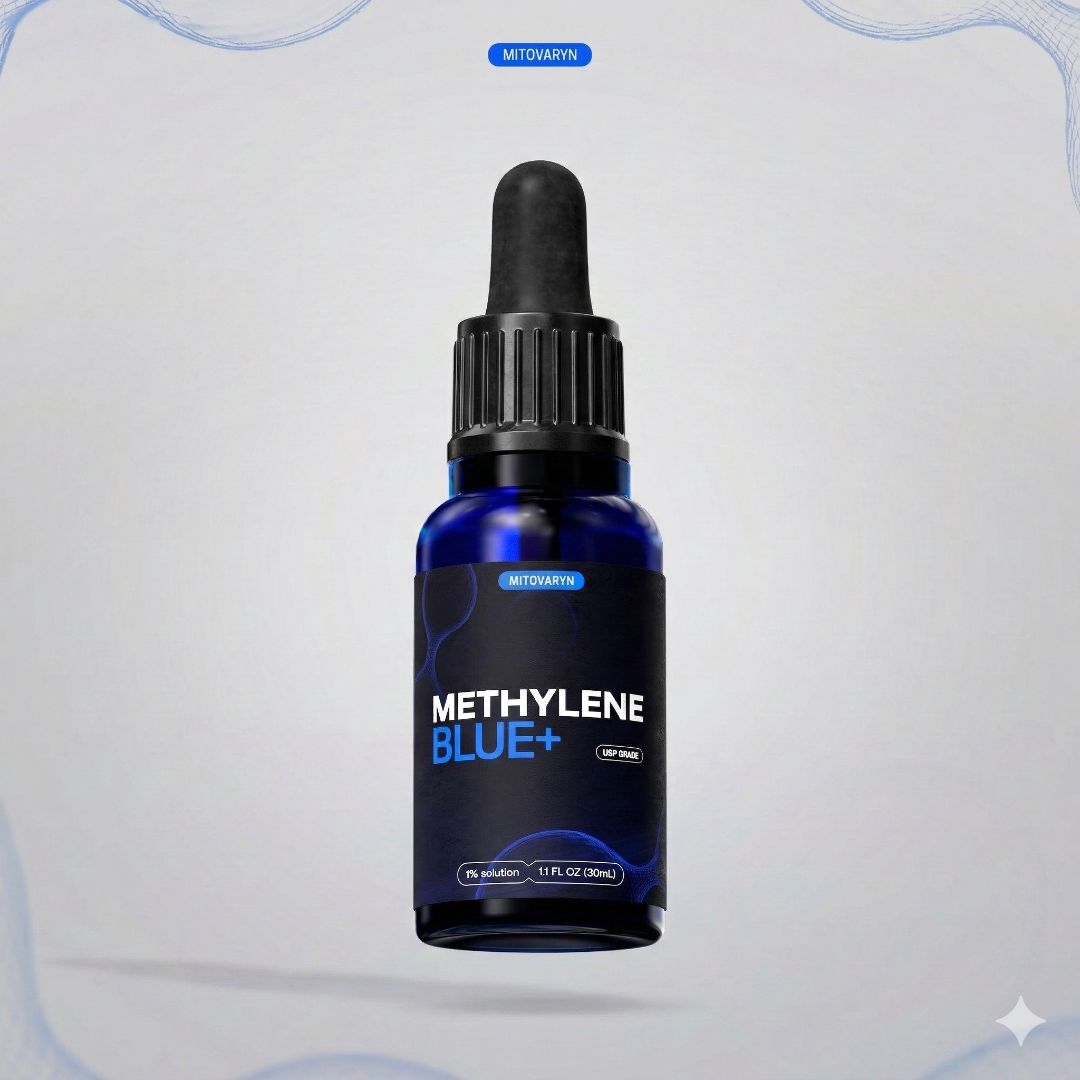 Methylene-blue product shown; creatine is not included
Methylene blue and creatine act on different parts of cellular energy biology, so the pairing is mechanistically plausible. Plausibility is not proof of synergy. PubMed searches through September 2026 did not identify a controlled human study testing the combination for strength, endurance, recovery, ATP production, focus, memory or fatigue.
The evidence at a glance
The original page blurred evidence for two separate substances into evidence for a stack. The accurate picture is less dramatic and more useful.
| Question | Current answer | Evidence level |
|---|---|---|
| Does creatine support rapid ATP regeneration? | Yes. Creatine increases phosphocreatine availability and supports repeated short-duration, high-intensity work. | Established |
| Does creatine improve training outcomes? | Often, particularly when paired with resistance training; response and outcome depend on the person and protocol. | Substantial |
| Does methylene blue affect mitochondrial biology? | Laboratory and animal work supports redox and electron-transport effects. Human wellness evidence is much smaller. | Mostly preclinical |
| Does methylene blue improve athletic performance? | No robust evidence establishes better strength, power, VO2 max, endurance or recovery in healthy athletes. | Not established |
| Has the pair been tested together? | No controlled human combination trial was identified in the September 2026 evidence search. | No direct trial found |
| Is synergy proven? | No. Separate mechanisms do not demonstrate an additive or multiplicative benefit. | Hypothesis only |
Bottom line: creatine's benefits should be credited to creatine. Any additional benefit, neutral effect or downside from adding methylene blue remains unknown.
How creatine and methylene blue differ
ATP is the immediate energy currency used by cells, but the body maintains it through several systems. Creatine and methylene blue enter the discussion at different points; that does not make them a proven pair.
| Feature | Creatine | Methylene blue |
|---|---|---|
| Proposed role | Phosphocreatine donates phosphate to ADP, rapidly regenerating ATP during high demand. | A dose-dependent redox compound studied as an alternative electron carrier in mitochondrial systems. |
| Strongest evidence | Higher tissue creatine stores, repeated high-intensity capacity and selected resistance-training outcomes.2 | Mechanistic, cell and animal research, with limited small human studies.5 |
| Cognitive evidence | Possible benefits for selected memory, attention and processing-speed outcomes; effects vary by population and task. | One small single-dose study reported neuroimaging and memory-retrieval changes in healthy adults. |
| Performance evidence | Substantial for appropriate high-intensity and resistance-training settings. | No robust evidence for strength, power, VO2 max, endurance or recovery in healthy athletes. |
| Key limitation | Does not create fitness without an effective training stimulus. | Wellness claims outrun clinical evidence and safety screening matters. |
| Combination evidence | No proof that methylene blue increases creatine uptake or phosphocreatine resynthesis. | No proof that creatine improves methylene-blue effectiveness or safety. |
Creatine monohydrate is the research benchmark; novel forms have not consistently shown superiority.3 Methylene blue's redox activity is dose-dependent, so “more mitochondrial support” is not a scientifically defensible assumption.
Synergy requires direct evidence. A proper trial would compare placebo, creatine alone, methylene blue alone and the combination. It would need pre-registered performance or cognitive outcomes and complete adverse-event reporting. No such human trial was identified.1
Performance, muscle and recovery claims
The evidence does not support describing the pair as a clinically validated pre-workout. Creatine can support training output; methylene blue has not been shown to enhance that effect.
| Outcome | Creatine alone | Extra benefit from methylene blue |
|---|---|---|
| One-repetition strength | Can augment resistance-training gains across many—but not all—studies | Not demonstrated |
| Repeated sprint or set capacity | Relevant to the phosphocreatine system and supported in suitable protocols | Not demonstrated |
| Muscle growth | May augment adaptation when paired with resistance training | No additive evidence |
| VO2 max | Not its primary established benefit | Not established |
| Endurance | Effects depend on event demands and may be neutral when added mass is disadvantageous | Not established |
| Recovery | Some evidence for selected markers and capacity; fundamentals remain primary | No direct stack evidence |
Claims such as “less fatigue,” “faster recovery” and “more sustained output” remain predictions when attributed to the combination. They should not be presented as observed human results.
A non-stimulant is not automatically an ergogenic aid. “Does not contain caffeine” describes what is absent; it does not prove performance, safety or better recovery.
Cognition, focus and mental-energy claims
Creatine has a developing cognitive evidence base. A 2024 systematic review and meta-analysis reported possible improvement in memory, attention time and processing speed, while finding no significant overall benefit for global cognition or executive function. The authors also graded important parts of the evidence as low certainty.4
Methylene blue's best-known healthy-volunteer study was small and acute. Twenty-six adults received a single dose or placebo before functional MRI and cognitive tasks; the study reported altered brain activity and a modest memory-retrieval result.6 It did not test daily use, creatine co-administration, academic achievement, workplace productivity or long-term brain health.
| Claim | Evidence-aware reading | Better conclusion |
|---|---|---|
| “Brain ATP stack” | Both substances are discussed in brain-energy research. | No direct study shows that the pair raises brain ATP or improves cognition more than either alone. |
| “Improves focus” | Focus is broad and easily affected by sleep, expectancy, anxiety and task design. | Require validated attention outcomes, not testimonials. |
| “Better during sleep loss” | Creatine has small studies in sleep-deprived settings. | This does not validate adding methylene blue or replacing sleep. |
| “No crash” | Neither ingredient is simply equivalent to caffeine. | Absence of a stimulant crash is not proof of cognitive benefit. |
| “Neuroprotective” | This term often comes from models of injury or disease. | It does not prove prevention or treatment of neurologic disease in healthy users. |
For adjacent evidence reviews, see methylene blue for studying, methylene blue for brain fog and methylene blue versus caffeine.
Timing, mixing and dosage: what the evidence cannot answer
No combination trial has established an ideal ratio, whether the ingredients should be taken together, whether workout timing matters or whether cycling changes the result. A schedule copied from a creator is not a validated stack protocol.
| Practical question | Evidence-based answer | Reason |
|---|---|---|
| Must they be taken together? | No evidence shows that same-time use improves uptake or outcomes. | They use different mechanisms and have not been compared by timing. |
| Is pre-workout timing best? | Not established for methylene blue; creatine works primarily by maintaining tissue stores. | An acute “feel” is not the same as a training effect. |
| Is there an ideal ratio? | No validated methylene-blue-to-creatine ratio exists. | A ratio would require dose-ranging combination studies. |
| Can they be premixed? | Avoid storing a homemade combined drink. | Creatine is less stable after prolonged time in solution, especially with heat and lower pH; methylene blue also stains and is light-responsive.3 |
| Should creatine be loaded? | Loading is not required to raise muscle stores. | Consistent lower daily intake works more gradually; this does not create a methylene-blue recommendation. |
| Can methylene blue be dosed from a creatine plan? | No. | One ingredient's evidence cannot set the other's exposure. |
Do not improvise methylene-blue concentration. Check the product label and the dosage-chart explainer. Medication screening and contraindications matter more than stack timing.
Safety: the combination does not erase individual risks
There is no direct human safety dataset for repeated methylene-blue-plus-creatine use. Creatine is generally well tolerated in healthy adults at commonly studied intakes, but methylene blue is pharmacologically active and has materially different risks.
| Situation | Why it matters | Prudent response |
|---|---|---|
| SSRIs, SNRIs, MAOIs or other serotonergic drugs | Methylene blue inhibits MAO-A and can contribute to serotonin syndrome.8 | Do not self-stack; ask the prescribing clinician or pharmacist. |
| G6PD deficiency | Prescription labeling contraindicates methylene blue because of hemolysis risk. | Avoid unless specifically managed by an appropriate clinician. |
| Pregnancy or breastfeeding | Methylene-blue labeling identifies fetal and breastfeeding concerns; wellness-stack safety is unestablished. | Do not rely on online stack guidance. |
| Kidney disease or abnormal renal tests | Creatine evidence in healthy adults should not be generalized to every renal condition; methylene-blue exposure may also change with impairment. | Seek individualized medical advice before either product. |
| Upcoming blood or urine testing | Creatine can affect serum creatinine interpretation, while methylene blue can discolor urine and interfere with some measurements. | Disclose all products to the clinician and laboratory. |
| Gastrointestinal symptoms | Creatine can cause GI upset, especially in large single servings; methylene blue may also cause nausea or abdominal symptoms. | Stop and obtain advice for severe, persistent or systemic symptoms. |
| Unexplained agitation, sweating, tremor, diarrhea or confusion | These can be warning signs of serotonin toxicity when methylene blue is combined with serotonergic exposure. | Seek urgent medical assessment. |
Current U.S. prescribing information is for intravenous methylene blue and cannot define the risk of an oral wellness stack. It nevertheless documents serious serotonin-syndrome, G6PD, pregnancy, lactation and organ-impairment considerations that consumer content should not omit.7
“Low dose” is not a safety screen. Product concentration, total exposure, medication list, health conditions and individual susceptibility all matter. See the full methylene-blue safety guide.
Product quality and athlete checks
Using two products expands—not reduces—the quality-control burden. Each should be evaluated separately, and the methylene-blue product should never be assumed equivalent to the creatine evidence base.
| Check | Methylene blue | Creatine |
|---|---|---|
| Identity | Verify the named compound and declared concentration. | Creatine monohydrate is the research benchmark. |
| Purity | Review batch-specific contaminant testing and documentation. | Prefer a reputable manufacturer with independent testing. |
| Serving accuracy | Liquid concentration and measuring method determine exposure. | Use the labeled mass; a household scoop may not be exact. |
| Claims | Reject claims of proven stack synergy, disease treatment or guaranteed cognition. | Distinguish supported training outcomes from universal promises. |
| Sport eligibility | Check the current governing-body rules and medication requirements. | Rules and contamination risk are separate questions. |
| Certification | A certificate of analysis is useful but does not establish efficacy or eligibility. | Tested-for-sport certification can reduce—not eliminate—contamination risk. |
The World Anti-Doping Agency updates its Prohibited List at least annually, and athletes remain responsible for substances found in their samples.9 Confirm the current rules with the relevant governing body rather than relying on an old article or ingredient list.
A rational way to evaluate the stack
Define the outcome
Strength, repeated-sprint ability, memory and subjective energy are different endpoints. Choose one measurable question.
Start with the established layer
Training, sleep, diet and creatine have clearer evidence than an experimental combination.
Screen methylene-blue risk
Review medications, G6PD status, health conditions, pregnancy considerations and product concentration with a qualified professional.
| If your goal is... | Evidence-led priority | Role of the proposed stack |
|---|---|---|
| More strength or repeated-set capacity | Progressive training, adequate food/protein and evidence-based creatine use | No proven advantage over creatine alone |
| Better endurance | Sport-specific programming, recovery, fueling and established endurance strategies | No demonstrated VO2-max or endurance benefit |
| Better concentration | Sleep, health assessment, workload design and treatment of underlying problems | No direct cognitive-combination evidence |
| Less fatigue | Identify sleep, training, nutritional or medical causes | Should not mask persistent or unexplained fatigue |
| Long-term health | Exercise, blood-pressure control, nutrition, sleep and preventive care | No evidence of longer life or slower aging |
Frequently asked questions
Can you take methylene blue and creatine together?
No controlled human trial was identified that establishes the combination's efficacy, ideal timing or safety. Because methylene blue has important contraindications and medication interactions, a clinician or pharmacist should review the complete situation before use.
Is methylene blue plus creatine proven to improve ATP?
No. Creatine supports rapid ATP regeneration through phosphocreatine, while methylene blue is studied in mitochondrial redox biology. No direct human trial shows that combining them increases ATP or performance more than creatine alone.
Does creatine make methylene blue work better?
That has not been demonstrated. A plausible relationship between two energy pathways does not prove that creatine changes methylene-blue absorption, response, effectiveness or safety.
Is the stack better than creatine alone?
There is no comparative evidence showing that it is. Creatine has a substantial standalone research base; the added value of methylene blue remains unknown.
Does the combination improve workouts?
Creatine can improve repeated high-intensity capacity and support training adaptations. Methylene blue has not been shown to add strength, power, endurance or training-volume benefits.
Does methylene blue plus creatine improve recovery?
No direct combination evidence establishes faster recovery. Creatine has some relevant standalone research, but sleep, nutrition, training load and time remain foundational.
Does the stack improve focus or memory?
Both ingredients have separate cognitive research, but findings vary by task and population. The combination has not been shown to improve focus, memory or productivity.
Is methylene blue and creatine a stimulant-free pre-workout?
It does not function like a standard caffeine product, but “stimulant-free” does not establish benefit or safety. Methylene blue is pharmacologically active and can interact seriously with serotonergic drugs.
Should methylene blue and creatine be mixed in the same drink?
No evidence shows a benefit from mixing them. Avoid storing a homemade combined drink because concentration, light exposure, staining and creatine stability in solution create avoidable uncertainty.
Can this stack be used with antidepressants?
Do not self-combine methylene blue with SSRIs, SNRIs, MAOIs or other serotonergic drugs. Methylene blue inhibits MAO-A and can contribute to potentially serious serotonin toxicity.
Is creatine safe for the kidneys?
Controlled research generally finds commonly studied creatine use well tolerated in healthy adults, but that does not cover every kidney condition. Creatine may also affect serum creatinine interpretation, so disclose use and obtain advice if kidney disease or abnormal tests are present.
What should tested athletes know about this stack?
Check the current prohibited list, medication rules and your governing body's guidance. Ingredient status and supplement contamination are separate issues, and athletes remain responsible for what is found in their samples.
Sources and evidence notes
- PubMed title/abstract search: “methylene blue” AND creatine. Reviewed September 2026. Returned mechanistic and unrelated records but no controlled human trial of the wellness stack.
- Kreider RB, et al. International Society of Sports Nutrition position stand: safety and efficacy of creatine supplementation in exercise, sport, and medicine. JISSN. 2017.
- Antonio J, et al. Common questions and misconceptions about creatine supplementation. JISSN. 2021.
- Xu C, et al. The effects of creatine supplementation on cognitive function in adults: a systematic review and meta-analysis. Frontiers in Nutrition. 2024; corrigendum published 2025.
- Yang SH, et al. Methylene blue connects the dots: from mitochondrial function to neuroprotection. International Journal of Molecular Sciences. 2017. Mechanistic and preclinical context.
- Rodriguez P, et al. Multimodal randomized functional MR imaging of the effects of methylene blue in the human brain. Radiology. 2016. Small, single-dose study—not a creatine-stack trial.
- DailyMed: Methylene Blue Injection prescribing information. Updated April 2026. Prescription labeling—not an oral stack protocol.
- Ramsay RR, et al. Methylene blue and serotonin toxicity: inhibition of monoamine oxidase A confirms a theoretical prediction. British Journal of Pharmacology. 2007.
- World Anti-Doping Agency: The Prohibited List. Current-list and annual-update resource.
Explore Mitovaryn with the evidence clear
Review product specifications and available documentation for Mitovaryn Methylene Blue. It does not contain creatine, and the methylene-blue-plus-creatine stack has not been clinically validated.
Medical disclaimer: Educational content only—not medical advice, diagnosis, treatment or a recommendation to combine supplements. Methylene blue has important contraindications and drug interactions. Consult a qualified clinician or pharmacist about medications, G6PD deficiency, kidney disease, pregnancy, breastfeeding, symptoms and individual risk.