
Mitovaryn Methylene Blue Learning Center
Methylene Blue Anti-Aging Cream: Evidence, Safety, and Formulation Limits
Methylene blue has produced interesting results in cultured human skin cells and reconstructed skin tissue. It has not yet been shown in robust clinical trials to reduce wrinkles, improve elasticity or slow skin aging in people.
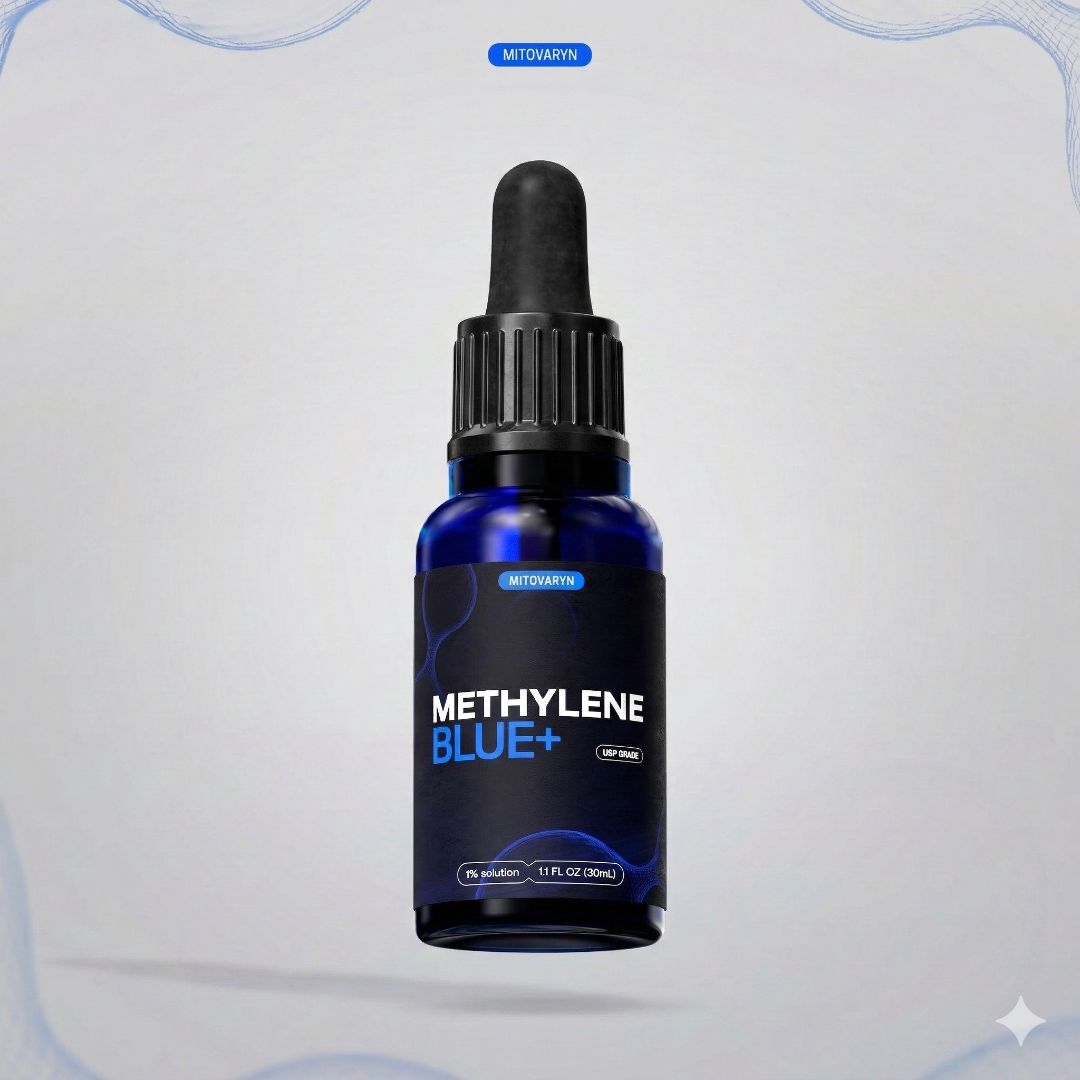 Oral product shown—not a topical cream
The research case for methylene blue in skincare is preclinical, not clinical. A widely cited 2017 study used donor-derived fibroblasts and laboratory-grown 3D skin—not people applying an anti-aging cream. The findings justify formulation research, but they do not establish a finished cream's effectiveness, ideal concentration, long-term safety or superiority to sunscreen and prescription retinoids.
The evidence at a glance
The strongest topical paper is biologically interesting and often marketed too aggressively. It assessed cells and reconstructed tissue under controlled laboratory conditions. It did not measure facial wrinkles, elasticity, pigmentation, tolerability or satisfaction in living participants.
| Question | Current answer | Evidence level |
|---|---|---|
| Does methylene blue affect skin cells? | Yes. Laboratory studies report effects on oxidative-stress, senescence and extracellular-matrix markers. | Preclinical |
| Was it tested in human-derived tissue? | Yes, in cultured fibroblasts and reconstructed 3D tissue made from human cells. | In vitro |
| Was an anti-aging cream tested on people? | Not in the pivotal 2017 study. | No clinical trial |
| Does it reduce wrinkles? | No robust human evidence establishes a visible wrinkle benefit. | Not established |
| Can it replace sunscreen? | No. Experimental UV findings do not establish a tested SPF or broad-spectrum protection. | Do not substitute |
| Can oral drops be used on skin? | No. Oral-product specifications do not establish topical concentration, stability, penetration or irritation safety. | Do not repurpose |
Bottom line: methylene blue is a candidate cosmetic ingredient, not a clinically proven anti-aging cream. The finished formulation—not the ingredient story alone—must be assessed.
What the 2017 skin study actually tested
Xiong and colleagues studied methylene blue in cultured human dermal fibroblasts from healthy donors and people with progeria, then in two commercial reconstructed human-skin models. The work appeared in Scientific Reports in 2017.1
| Experiment | Reported finding | Translation limit |
|---|---|---|
| Fibroblast culture | Lower mitochondrial reactive-oxygen signal and increased proliferation in the tested cell systems | Cells in culture do not reproduce intact skin, exposure, metabolism or cosmetic use. |
| Senescence markers | Changes in p16, SA-β-gal and antioxidant-response markers | A molecular marker is not a wrinkle, elasticity or age-reversal outcome. |
| 3D irritation model | No acute viability-defined irritation across tested concentrations after 60 minutes | It was reconstructed tissue, not a human patch test or months-long consumer study. |
| Two-week 3D exposure | Selected concentrations increased viability, hydration and dermal-layer thickness measures | Laboratory hydration and thickness do not prove visible benefit in living skin. |
| Matrix proteins | Elastin and selected extracellular-matrix genes or proteins changed | The study did not demonstrate firmer or more elastic skin in participants. |
| Scratch assay | Fibroblast migration in an in-vitro wound model | A cell-culture scratch is not evidence that a cream treats wounds. |
“Human skin model” does not mean human clinical trial. The tissue was grown in a laboratory. No participant applied a methylene-blue cream to the face, and no clinical photoaging scale was assessed.
What the findings do—and do not—mean
The paper supports continued research into low-concentration topical formulations. It does not authorize a chain of claims from “antioxidant in cells” to “reverses wrinkles in people.”
| Marketing claim | What the research supports | What remains unproven |
|---|---|---|
| “Boosts collagen” | Selected matrix-related expression changed in reconstructed tissue. | Clinically meaningful facial collagen remodeling or improved firmness. |
| “Increases hydration” | An electrical-impedance hydration measure increased in a 3D model. | Better hydration than the cream vehicle or a standard moisturizer in people. |
| “Reverses cellular aging” | Several senescence-associated markers changed in cultured cells. | Reversal of biological or visible skin aging. |
| “Heals skin” | Migration changed in an in-vitro scratch assay. | Treatment of cuts, ulcers, burns, scars or impaired wound healing. |
| “Reduces redness” | No direct clinical redness endpoint in the pivotal study. | Benefit for rosacea, dermatitis or inflammatory skin disease. |
| “Safe for long-term use” | Short laboratory-model tolerability observations | Long-term facial, eye-area, sensitization, absorption and systemic safety. |
Why the finished formulation matters
A promising ingredient can fail—or behave differently—when placed in a real cream. Concentration, vehicle, pH, oxidation state, penetration, light exposure, packaging and other ingredients can change performance and tolerability.
Concentration
The 2017 model showed a non-linear response: higher tested concentrations colored the tissue and some reduced viability. “More” was not better.
Vehicle
A base cream can drive hydration and appearance on its own. A clinical trial needs a vehicle control to isolate methylene blue's contribution.
Stability
Methylene blue is redox-active and light-responsive. Packaging and storage can affect the form that reaches skin.
| Formulation question | Why it matters |
|---|---|
| What is the exact concentration? | “Contains methylene blue” does not reveal exposure or comparability with a study. |
| Was the finished product stability-tested? | Heat, light, air, pH and time may alter color, chemistry or potency. |
| Was it tested against its vehicle? | Moisturizers can improve hydration and fine-line appearance without the active ingredient. |
| Was skin penetration measured? | Too little delivery may be ineffective; more penetration may change local or systemic risk. |
| Were sensitization and eye-area risks assessed? | A reconstructed irritation test cannot answer every real-world tolerability question. |
| Was staining evaluated? | Methylene blue is a dye and may discolor skin, nails, hair, fabric or surfaces. |
UV-protection findings do not make it sunscreen
A 2021 laboratory study reported that methylene blue absorbed UV wavelengths and reduced UVB-related DNA damage and cell death in cultured keratinocytes and reconstructed skin models.2 That is preclinical evidence, not a labeled sun-protection factor.
| Question | What is known | What is missing |
|---|---|---|
| Does methylene blue interact with light? | Yes. It absorbs visible and ultraviolet wavelengths and can participate in photochemical reactions. | A simple assumption that all light interactions are protective on human skin. |
| Did the 2021 study show UV protection? | It reported protective laboratory endpoints in cells and reconstructed tissue. | Clinical sunburn, UVA protection, photoaging or skin-cancer outcomes. |
| Does a cream have an SPF? | Only if the finished product is tested and labeled under applicable sunscreen requirements. | An ingredient paper cannot provide an SPF value to another formula. |
| Can it replace broad-spectrum sunscreen? | No. Daily sunscreen has direct human evidence for reducing photoaging. | No reason to substitute an experimental ingredient. |
In a randomized trial of 903 adults, daily broad-spectrum sunscreen use produced 24% less skin aging over 4.5 years than discretionary use.3 That evidence is much closer to the outcome people actually care about.
Do not use methylene blue as homemade sunscreen. It has no transferable SPF, and uneven DIY application cannot provide validated UVA or UVB protection.
Why oral drops should not be mixed into skincare
An oral liquid is not a cosmetic concentrate. Adding drops to a moisturizer creates an untested product with unknown uniformity, stability, preservative performance, skin delivery and exposure.
| DIY problem | Why it matters |
|---|---|
| Unknown final concentration | Drop size, starting concentration and incomplete mixing make exposure unreliable. |
| Broken preservation system | Adding water-based liquid can alter a cream's microbial protection and shelf life. |
| Changed pH and stability | The mixture may affect the active, vehicle or other skincare ingredients. |
| Uneven application | Concentrated spots can increase discoloration or irritation. |
| Route mismatch | Oral quality testing does not establish topical penetration, sensitization or eye safety. |
| False reassurance from “USP grade” | Identity and purity do not turn an oral product into a validated cosmetic formula. |
Mitovaryn Methylene Blue is not a topical cream. Do not apply it to skin, mix it into cosmetics, use it around the eyes or put it on wounds.
What has stronger evidence for skin aging?
Skin aging is influenced by intrinsic biology and cumulative environmental exposure. The most defensible routine focuses on interventions with human outcomes, then treats experimental ingredients as optional research—not replacements.
| Approach | Evidence-led role | Important caveat |
|---|---|---|
| Broad-spectrum sunscreen | Strong foundation Reduces UV exposure and has randomized human photoaging evidence. | Correct amount, coverage and reapplication still matter. |
| Shade and protective clothing | Reduce cumulative UV exposure without relying on one topical product. | Protection depends on fabric, coverage, time and environment. |
| Moisturizer | Supports barrier comfort and hydration; can temporarily soften fine-line appearance. | Hydration is not structural age reversal. |
| Topical tretinoin | Prescription retinoid with human evidence for improving photoaged skin over months.4 | Irritation and pregnancy considerations require appropriate guidance. |
| Avoiding tobacco smoke | Reduces a major source of oxidative and structural skin stress. | Benefits extend far beyond skin appearance. |
| Dermatology evaluation | Distinguishes photoaging from pigment disorders, dermatitis, rosacea and suspicious lesions. | Changing lesions require medical assessment, not cosmetic treatment. |
| Methylene-blue cream | Experimental Interesting cell and reconstructed-tissue evidence. | No robust human efficacy base or standardized formula. |
Topical safety cannot be inferred from one ingredient study
A finished cosmetic can cause irritant or allergic contact dermatitis even when individual ingredients appear tolerable. Risk depends on concentration, vehicle, preservatives, fragrance, co-actives, application area, frequency and skin-barrier condition.
| Situation | Why extra caution is needed | Safer response |
|---|---|---|
| Sensitive skin, eczema or rosacea | A compromised or reactive barrier may respond differently from a laboratory model. | Ask a dermatologist and avoid introducing multiple actives together. |
| Eye area or mucous membranes | Eye irritation and accidental exposure were not answered by the anti-aging study. | Use only products specifically assessed and directed for that area. |
| Broken, burned or infected skin | Barrier loss changes penetration and a cosmetic is not a wound treatment. | Seek appropriate medical care. |
| Serotonergic medication | Methylene blue can inhibit MAO-A; systemic exposure from an untested topical formula may be unknown. | Ask the prescriber or pharmacist before use. |
| G6PD deficiency | Systemic methylene-blue labeling contains a serious contraindication. | Do not assume topical use eliminates concern; obtain medical advice. |
| Pregnancy or breastfeeding | Relevant cosmetic anti-aging safety data are inadequate. | Use clinician-approved skincare. |
Current U.S. methylene-blue prescribing information concerns an intravenous drug and cannot quantify topical cosmetic risk. It nevertheless identifies serotonin syndrome, G6PD-related hemolysis and pregnancy/lactation issues that should not be dismissed when a topical product lacks absorption data.5 Laboratory research also confirms potent reversible MAO-A inhibition.6
Stop use and seek care for severe swelling, blistering, breathing difficulty, widespread hives, intense eye exposure or systemic symptoms. Persistent burning, rash or discoloration warrants professional advice.
How to assess a methylene-blue cream claim
Ingredient-level plausibility is only the first step. Ask for evidence on the exact product sold.
| Evidence question | Stronger answer | Red flag |
|---|---|---|
| Was the finished cream tested? | Randomized, blinded, vehicle-controlled human study | Only linking the 2017 cell paper |
| Were meaningful outcomes measured? | Validated wrinkle, elasticity, pigmentation and tolerability measures | Only antioxidant or “cellular energy” language |
| Is concentration disclosed? | Exact methylene-blue amount with stability data | “Proprietary complex” without exposure |
| Was the formula compared with its base? | Vehicle control isolates the active ingredient | Before-and-after photos without a comparator |
| Were adverse effects reported? | Dropouts, irritation, staining and sensitization disclosed | “Side-effect free” or “safe for everyone” |
| What kind of claim is made? | Appearance claims proportional to evidence | Claims to treat wounds, rosacea, dermatitis or reverse aging |
In the United States, intended use helps determine whether a topical product is regulated as a cosmetic, a drug or both. Claims to treat disease or affect body structure or function can change the regulatory category.7
Oral methylene blue and skin aging are separate questions
The existence of topical laboratory findings does not show that swallowing methylene blue improves skin. Route changes exposure, tissue concentration, formulation needs and risk. No robust human evidence shows that oral consumer use improves wrinkles, collagen, hydration, redness or skin elasticity.
| Route | Relevant evidence | What not to infer |
|---|---|---|
| Cell culture | Direct exposure of isolated cells to controlled concentrations | That oral dosing reaches skin at the same concentration |
| Reconstructed skin | Controlled laboratory tissue exposure | Clinical tolerability or visible facial improvement |
| Finished topical cream | Must be established for the exact formula | That any blue-colored mixture is equivalent |
| Oral drops | A separate systemic-use evidence and safety question | Topical anti-aging efficacy or permission to apply to skin |
See methylene blue for longevity, methylene blue and biological age, how methylene blue works and methylene blue uses.
Frequently asked questions
Does methylene-blue anti-aging cream work?
It is not established. Laboratory studies in cells and reconstructed skin are promising, but robust human trials have not shown that a methylene-blue cream reduces wrinkles, improves elasticity or slows skin aging.
Was methylene blue tested on human skin?
Researchers tested human-derived fibroblasts and reconstructed 3D tissue made from human skin cells. That is not the same as applying a finished cream to living participants.
Does methylene blue increase collagen or elastin?
A 2017 laboratory study reported changes in elastin and selected extracellular-matrix markers. It did not establish clinically meaningful collagen remodeling, firmness or elasticity in people.
Can methylene-blue cream reduce wrinkles?
No robust human clinical evidence establishes wrinkle reduction. Cell markers, tissue thickness and laboratory hydration cannot substitute for validated facial-wrinkle outcomes.
Can methylene blue be used as sunscreen?
No. Experimental UV-protection findings do not provide a tested SPF or broad-spectrum claim. Use a properly tested and labeled broad-spectrum sunscreen.
Will methylene blue stain skin?
It can. Methylene blue is a dye, and staining risk depends on concentration, formulation and exposure. The reconstructed-skin study observed blue coloring at higher tested concentrations.
Can I mix methylene-blue drops into moisturizer?
No. DIY mixing creates unknown concentration, stability, uniformity, preservation and skin-delivery risks. Oral drops are not a cosmetic concentrate.
Can Mitovaryn Methylene Blue be applied to skin?
No. Mitovaryn Methylene Blue is not a topical anti-aging cream and should not be applied to skin, mixed into cosmetics, used near the eyes or placed on wounds.
Is topical methylene blue safe with antidepressants?
Systemic absorption from untested formulas may be uncertain, while methylene blue can inhibit MAO-A and interact seriously with serotonergic drugs. Ask the treating prescriber or pharmacist before use.
Is methylene-blue cream safe during pregnancy?
Adequate cosmetic anti-aging safety evidence is lacking. Pregnancy labeling for systemic methylene blue also raises concern, so use skincare approved by the treating clinician.
What has stronger evidence for preventing skin aging?
Daily broad-spectrum sunscreen has randomized human evidence for reducing photoaging. Prescription topical tretinoin also has human evidence for improving established photodamage, with appropriate medical guidance.
What should a credible cream study include?
It should test the exact finished formula in people against its vehicle, use validated appearance and tolerability measures, disclose concentration and adverse effects, and run long enough to assess durability.
Sources and evidence notes
- Xiong ZM, et al. Anti-Aging Potentials of Methylene Blue for Human Skin Longevity. Scientific Reports. 2017. Cell-culture and reconstructed-skin evidence—not a human cream trial.
- Xiong ZM, et al. Ultraviolet radiation protection potentials of Methylene Blue for human skin and coral reef health. Scientific Reports. 2021. Preclinical evidence.
- Hughes MCB, et al. Sunscreen and prevention of skin aging: a randomized trial. Annals of Internal Medicine. 2013.
- Gilchrest BA. A review of skin ageing and its medical therapy. British Journal of Dermatology. 1996. Tretinoin and photodamage evidence context.
- DailyMed: Methylene Blue Injection prescribing information. Updated April 2026. Systemic safety labeling—not a topical protocol.
- Ramsay RR, Dunford C, Gillman PK. Methylene blue and serotonin toxicity. British Journal of Pharmacology. 2007. MAO-A evidence.
- U.S. FDA. Is It a Cosmetic, a Drug, or Both? Intended-use and claims guidance.
Review Mitovaryn Methylene Blue accurately
Explore specifications and available documentation for Mitovaryn's oral methylene-blue product. It is not an anti-aging cream and should not be repurposed for topical use.
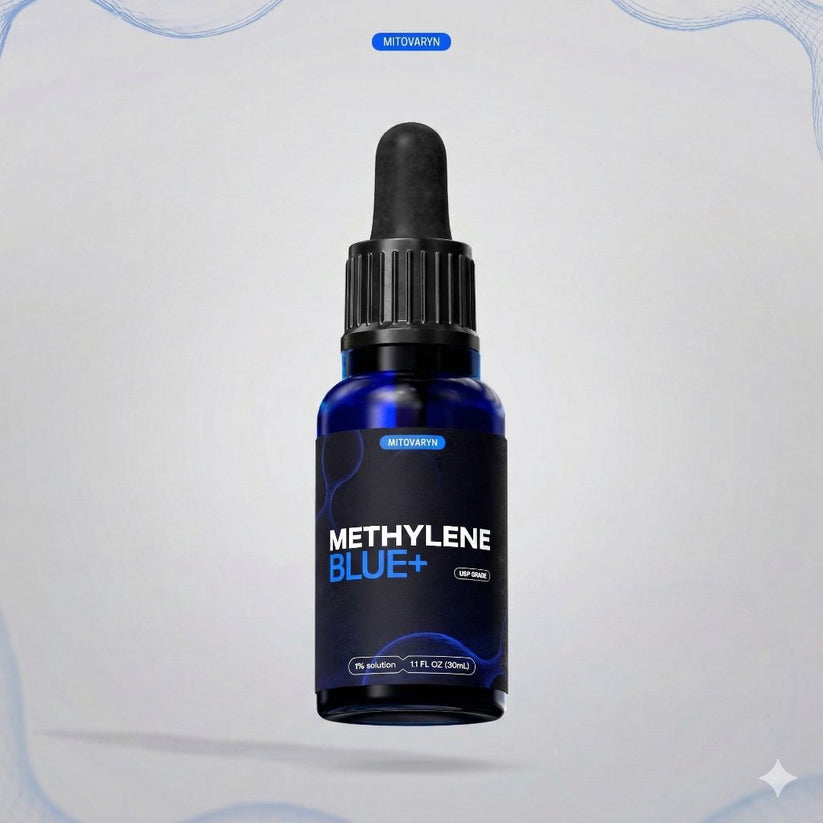
Medical disclaimer: Educational content only—not medical advice, diagnosis, treatment or a recommendation to formulate or apply methylene blue topically. Mitovaryn Methylene Blue is not a skin cream. Seek qualified dermatologic or medical guidance for skin concerns, reactions, medication interactions and changing lesions.