Mitovaryn Methylene Blue Learning Center
Methylene Blue Pre-Workout Guide: Evidence, Timing and Safety
Methylene blue’s redox chemistry explains why it appears in pre-workout conversations, but no convincing controlled human evidence shows that oral use improves workout energy, endurance, VO₂ max, strength, power, pump or recovery. Here is how to separate a mitochondrial hypothesis from a tested sports benefit.
Methylene blue is not an evidence-based pre-workout supplement. It is pharmacologically active, not a gentler version of caffeine, and no validated oral timing or performance dose exists. Experimental mitochondrial findings justify research questions—not claims of more energy or endurance. Medication interactions, G6PD deficiency, product quality and sport rules should be reviewed before anyone treats it as a training tool.
Product transparency without workout promises
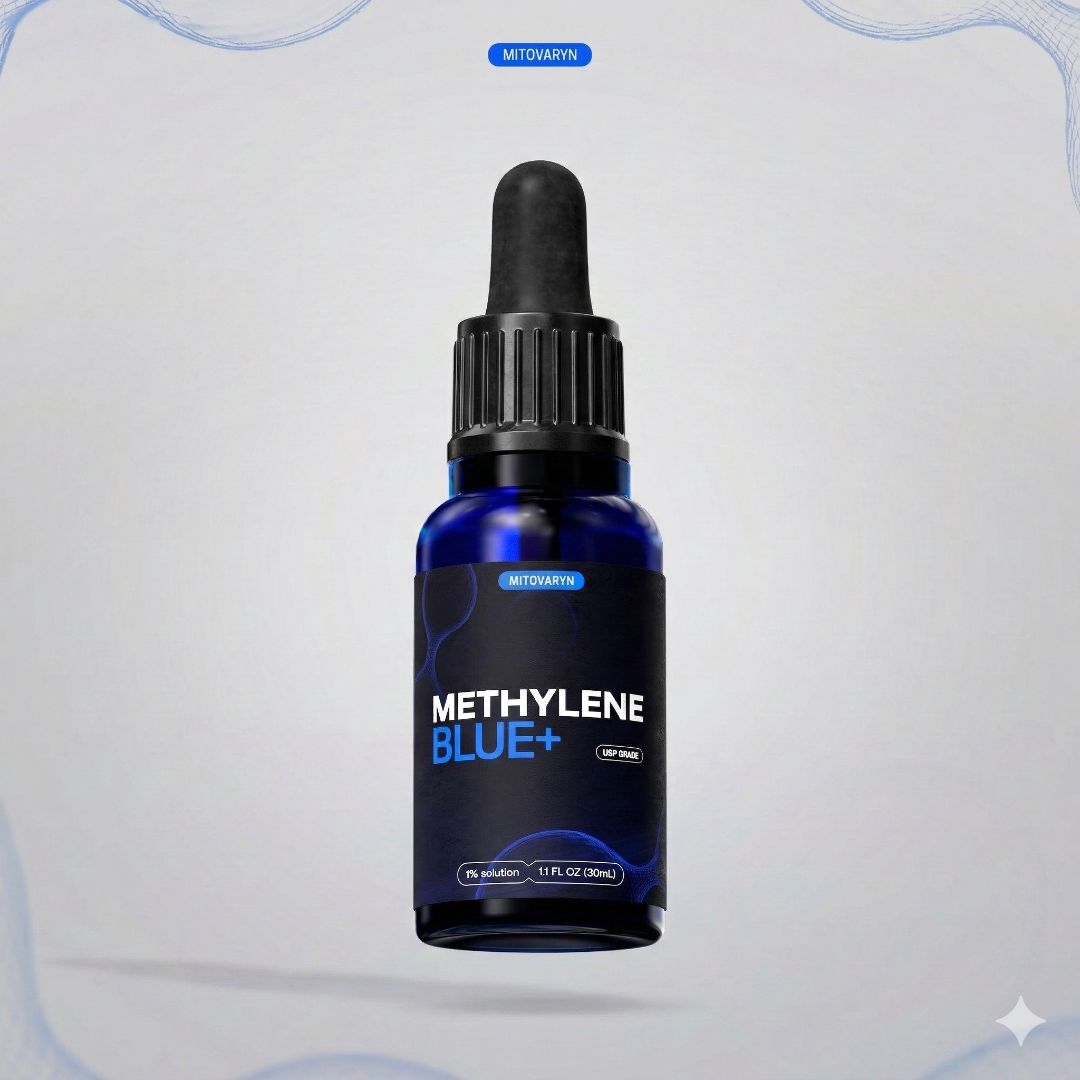
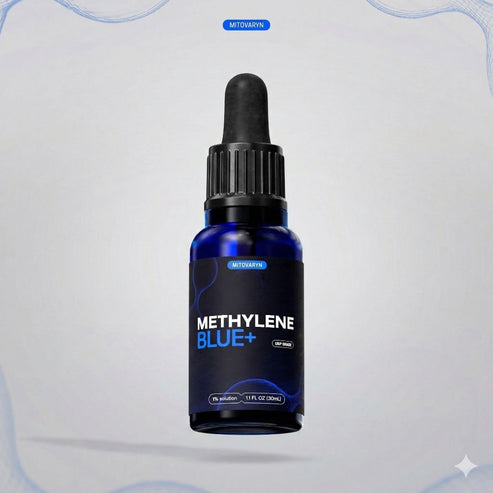
Mitovaryn provides a clearly labeled oral formula and product-specific testing information. Those details help evaluate the bottle; they do not prove a pre-workout effect, establish personal suitability or replace medication and sport-rule screening.
“Pre-workout” is a timing label, not proof of benefit
A pre-workout can be a branded multi-ingredient powder, a single ingredient or simply something taken before exercise. The label does not tell you what the ingredient does—or whether it improves performance at all.
A meaningful claim must name a specific outcome, population and test. “More energy” might mean feeling alert, completing more repetitions, sustaining higher power, running a faster time trial or showing a higher VO₂ max. Those outcomes are not interchangeable.
| Claim | What should be measured | What is not enough |
|---|---|---|
| Workout energy | Blinded ratings plus objective work completed. | Feeling different after seeing a blue liquid. |
| Endurance | Time trial, time to exhaustion or sustainable power. | Respiration in isolated cells or mitochondria. |
| Strength or power | Maximum force, bar velocity, jump height or sprint time. | A general ATP mechanism. |
| Focus | Reaction time, accuracy or decisions during exercise. | A resting memory task. |
| Recovery | Restoration of function or next-session performance. | Less soreness or one unusually good workout. |
Evidence standard: a mechanism can explain why a trial is worth running. It cannot replace a trial in trained people using the intended product, route and performance endpoint.
Is methylene blue a stimulant?
Methylene blue is not caffeine, amphetamine or a conventional sympathomimetic pre-workout ingredient. But calling it simply “non-stimulatory” can imply inertness or predictability that the evidence does not support.
Methylene blue is biologically active across several systems. Laboratory work shows potent reversible inhibition of monoamine oxidase A, an enzyme involved in serotonin and other monoamine metabolism.8 Current U.S. prescribing information carries a boxed warning about serious or fatal serotonin syndrome when methylene blue injection is combined with serotonergic drugs and opioids; it also identifies dextromethorphan as relevant.7
| Feature | Caffeine | Methylene blue |
|---|---|---|
| Primary comparison | Adenosine-receptor antagonist with established alertness and performance research.10 | Redox-active drug with multiple biochemical actions. |
| Perceptible “kick” | Common, although individual response varies. | Not a validated or required effect. |
| Human exercise evidence | Substantial across several performance domains. | No convincing controlled oral pre-workout evidence. |
| Key caution | Sleep, anxiety, heart rate, habituation and individual response. | Serotonergic interactions, G6PD deficiency, route and dose uncertainty. |
Someone may report calm focus, alertness or no obvious sensation. None of those experiences proves more muscle ATP or better training performance. Read the full methylene blue versus caffeine comparison.
The mitochondrial hypothesis—and its limits
Methylene blue can cycle between oxidized and reduced forms. In experimental systems, that redox activity can alter electron transfer, respiratory-complex activity, oxygen consumption, ATP-related measurements and reactive-species production.
A cultured-cell study reported greater Complex IV activity and oxygen consumption after nanomolar exposure. The researchers proposed cycling between methylene blue and leucomethylene blue through NAD(P)H-dependent reduction and cytochrome c reoxidation.1 This is a biochemical observation, not a pre-workout trial.
More oxygen consumption does not always mean more usable ATP
Respiration can rise because ATP-linked energy production increased, because demand rose or because mitochondrial coupling became less efficient. Isolated rat-liver-mitochondria research found conditions in which methylene blue increased oxygen use while the ATP/ADP ratio fell, alongside uncoupling and inhibition of ATP-related machinery.3
Other isolated-mitochondria work found that methylene blue did not universally bypass a Complex III antimycin block, challenging a simplified electron-shortcut story.4 Experimental concentration, substrate, tissue and redox state can change the result.
The common leap: “changes electron transfer” becomes “makes more ATP,” then “creates better workout energy.” Each arrow needs direct evidence; the last one has not been established in exercising humans.
For the deeper pathway review, see how methylene blue works in mitochondria and methylene blue for ATP production.
What the pre-workout evidence actually contains
Direct evidence is sparse. Most citations used to promote methylene blue before training were designed around cells, isolated mitochondria, nonhuman exercise, memory tasks or approved medical use—not oral use in healthy athletes.
| Evidence | What researchers tested | What it cannot prove |
|---|---|---|
| Cultured cells Atamna, 2008 | Complex IV, oxygen consumption and biochemical pathways. | Workout energy or performance in people. |
| Exercising dogs Imai, 1986 | Cardiac output and oxygen consumption during treadmill exercise with infusion. | Oral pre-workout benefit in humans; the cardiac-output/oxygen relationship was unaffected. |
| Isolated mitochondria | Respiration, coupling, ATP/ADP and reactive species under controlled laboratory conditions. | That net exercise efficiency improves in an intact person. |
| 26 healthy adults Rodriguez, 2016 | Acute functional MRI and memory tasks after one oral exposure. | Exercise focus, reaction time, VO₂ max, strength or muscle ATP. |
| DailyMed label | Approved IV treatment of acquired methemoglobinemia and medical risks. | An oral fitness indication, timing window or performance dose. |
The randomized brain-imaging study reported altered task-related activity and a 7% increase in correct responses during one memory-retrieval task.5 It did not include exercise, trained athletes or a sports endpoint. The result should not be rewritten as “better mind-muscle connection.”
Evidence conclusion: no cited controlled trial shows that taking oral methylene blue before exercise improves time-trial performance, VO₂ max, repeated-sprint ability, strength, power, training volume or recovery.
Endurance, VO₂ max, strength, pump and recovery
Endurance and VO₂ max
Endurance depends on ventilation, hemoglobin, cardiac output, muscle oxygen extraction, mitochondrial metabolism, fuel availability, heat management, biomechanics and pacing. VO₂ max requires progressive gas-exchange testing. Resting oxygen saturation, cellular oxygen consumption and subjective breathing do not substitute for it.
The directly exercise-related PubMed study often found in searches involved dogs receiving an infusion. It reported that the relationship between cardiac output and total-body oxygen consumption during treadmill exercise was unaffected by methylene blue.2 This is not evidence for an oral human pre-workout.
Strength, power and “pump”
Immediate maximal efforts rely heavily on stored ATP, phosphocreatine, neuromuscular recruitment and technique. No controlled human evidence shows that oral methylene blue increases one-repetition maximum, bar velocity, sprint speed, jump height or repetitions to failure.
Methylene blue should not be described as a nitric-oxide “pump” ingredient. It can affect nitric-oxide signaling and vascular tone in medical contexts, but those hemodynamic actions cannot be converted into a claim of improved muscle blood flow in healthy lifters.
Recovery
Feeling mentally alert after training is not the same as restoring muscle function, glycogen, fluid balance or tissue capacity. No controlled athlete evidence shows faster force recovery, less muscle damage, improved next-session output or better long-term adaptation.
Training fundamentals remain primary: appropriate programming, adequate energy and protein, carbohydrate availability, hydration, electrolytes, sleep and injury care have direct relevance that a speculative pre-workout mechanism cannot replace.
Continue to the athletic-performance guide, VO₂ max review and oxygen-efficiency review.
Timing and dose: no pre-workout protocol is established
No clinically validated timing window or oral athletic-performance dose exists. Online advice such as “30 minutes before training” is convention, not a conclusion from controlled performance trials.
A real timing study would need the exact formulation, oral absorption profile, food conditions, blood exposure, intended outcome and objective exercise testing. Even a concentration peak would not prove that performance peaks with it.
- Immediate effect: a sensation is not blinded evidence of efficacy.
- Daily use: repeated-dose performance and long-term safety have not been established.
- Evening use: being caffeine-free does not prove sleep neutrality.
- Medical dosing: IV dosing for methemoglobinemia is not an oral workout protocol.
No dosing schedule is provided here. Cell concentrations, animal doses, IV labels, drop counts and oral products are not interchangeable. See the dosage evidence guide and concentration chart.
Can methylene blue be combined with caffeine, creatine or a pre-workout blend?
A stack must be evaluated ingredient by ingredient. “No known interaction” is not the same as studied compatibility, especially when a commercial powder may contain stimulants, serotonergic agents, botanicals, nootropics or undeclared ingredients.
| Combination | Evidence question | Practical boundary |
|---|---|---|
| Methylene blue + caffeine | Has the exact combination improved performance without excess heart rate, anxiety or sleep disruption? | No established combined pre-workout protocol. |
| Methylene blue + creatine | Do distinct mechanisms produce additive benefit in humans? | Creatine evidence does not validate methylene blue or synergy. |
| Multi-ingredient powder | Does every ingredient and dose pass medication and safety review? | Proprietary blends make attribution and interaction review harder. |
| Serotonergic medicine, opioid or dextromethorphan | Has a clinician or pharmacist reviewed the combination? | Potentially serious serotonin-syndrome risk requires professional review. |
Creatine has a substantial human evidence base and a defined relationship with phosphocreatine buffering; methylene blue has different redox pharmacology.11 Read methylene blue and creatine and the methylene blue and NAD⁺ stack review.
Do not use a stack to mask a training problem. Persistent exhaustion, declining output, unusual breathlessness, chest symptoms, dizziness or weakness deserve recovery changes and, when appropriate, medical evaluation—not additional ingredients.
Safety screening matters before exercise
The safety evidence most relevant to warnings comes from medical methylene-blue products, not oral pre-workout trials. Current U.S. prescribing information is for IV treatment of acquired methemoglobinemia, so it does not establish the safety of oral fitness use. It does, however, identify hazards that should not be erased by a supplement label.7
| Situation | Why it matters around training | Safer action |
|---|---|---|
| SSRI, SNRI, MAOI, opioid, dextromethorphan or another serotonergic agent | Serious or fatal serotonin syndrome has been reported with methylene-blue class products. | Have a prescriber or pharmacist review every medicine and supplement. |
| G6PD deficiency | Severe hemolysis and anemia may occur; the IV label lists it as a contraindication. | Do not self-experiment; obtain medical guidance. |
| Pregnancy, breastfeeding, kidney or liver disease | The label contains population-specific warnings or monitoring considerations. | Obtain individualized professional advice. |
| Dizziness, confusion or vision change | Exercise, driving and equipment use can become unsafe. | Stop the activity and seek appropriate assessment. |
| Unknown-grade or poorly documented product | Identity, concentration and contaminants may not match the label. | Review batch-specific methods, results and traceability. |
Seek urgent medical help for agitation or confusion with fever, sweating, diarrhea, rapid heart rate, tremor, muscle rigidity, jerking movements, poor coordination or seizures—especially after combining methylene blue with a serotonergic medicine, opioid or dextromethorphan.
Quality is necessary, but it is not efficacy
A meaningful certificate or report should connect the submitted sample to a lot, identify methods, state results and address relevant contaminants. Testing can support identity, assay or selected purity questions. It cannot prove absorption, workout benefit, medication compatibility or a safe dose.
Read methylene blue drug interactions, side effects, how to read lab tests and Mitovaryn lab results.
Competitive athletes: check the current rules
Methylene blue was not individually named in the searchable 2026 WADA Prohibited List reviewed for this guide.9 That observation is not anti-doping clearance. WADA categories can cover substances or methods that are not individually listed, other organizations may apply additional rules, and product contamination can create separate risk.
- Check the exact substance, product, route and intended use with the organization governing the sport.
- Use an appropriate sport-supplement certification program when applicable; a general purity report is not anti-doping certification.
- Keep a dated record of the search and understand any strict-liability rules that apply.
Do not rely on a seller’s statement. “Not a stimulant,” “not named,” “natural-feeling” and “third-party tested” do not guarantee eligibility or a negative test.
How to audit a pre-workout claim
Performance marketing often begins with a real biochemical observation and silently changes the model, route or outcome.
- Find the study: a citation should lead to the paper, not another sales page.
- Name the model: cell, isolated mitochondrion, animal, patient, healthy adult or trained athlete.
- Match the exposure: formulation, concentration, route and duration should resemble the claim.
- Match the endpoint: oxygen consumption, fMRI and memory are not exercise performance.
- Check controls: placebo, blinding and randomization reduce expectation effects.
- Read harms: interactions, exclusions and withdrawals belong beside benefit.
- Separate testing: a COA can characterize a sample; it cannot prove athletic efficacy.
Better wording: experimental systems report context-dependent mitochondrial effects; controlled human pre-workout benefits remain unproven. See myths and misconceptions.
Methylene blue pre-workout: frequently asked questions
Is methylene blue a good pre-workout?
It is not an evidence-based pre-workout. No convincing controlled human trial shows that oral methylene blue improves workout energy, endurance, VO₂ max, strength, power, pump or recovery.
Is methylene blue a stimulant?
It is not caffeine or a conventional stimulant, but it is pharmacologically active and can inhibit monoamine oxidase A. Calling it simply non-stimulatory understates its interaction and central effects.
Does methylene blue give an immediate energy boost?
An immediate and reliable pre-workout energy effect has not been established in blinded human exercise trials. Subjective sensation does not prove increased ATP or work capacity.
Can methylene blue improve endurance or VO₂ max?
No convincing human evidence shows improved endurance or VO₂ max. Cell respiration, resting oxygen saturation and a dog infusion study cannot establish an oral benefit in athletes.
Can methylene blue increase strength, power or pump?
No controlled human evidence establishes greater strength, sprint power, repetitions or muscle pump. Mitochondrial theory and medical vascular effects are not substitutes for performance testing.
How long before a workout should methylene blue be taken?
No clinically validated pre-workout timing window exists. Minute-based online schedules are not supported by product-specific pharmacokinetic and performance trials.
What is the pre-workout dose of methylene blue?
No validated oral athletic-performance dose exists. IV dosing for methemoglobinemia, cell concentrations, animal doses and drop counts should not be converted into a workout protocol.
Can methylene blue be combined with caffeine?
No established combined protocol exists. The complete ingredient list, medications, cardiovascular response, anxiety and sleep effects require review rather than assuming different mechanisms are automatically compatible.
Can methylene blue be combined with creatine?
Creatine and methylene blue have different proposed mechanisms, and creatine’s human evidence does not prove additive benefit or safety when combined with methylene blue.
Is methylene blue suitable for evening workouts?
This has not been established. Being caffeine-free does not prove that methylene blue is sleep-neutral, and sleep is often more important to recovery than an unproven pre-workout ingredient.
Who should be cautious with methylene blue before exercise?
People taking serotonergic medicines, opioids or dextromethorphan and those with G6PD deficiency, pregnancy, breastfeeding, kidney disease or liver disease need professional review.
Is methylene blue prohibited in competitive sport?
It was not individually named in the searchable 2026 WADA list reviewed here, but that is not competition clearance. Athletes should verify the exact substance, route and product with their governing body.
Primary and official sources
- Atamna H, et al. Methylene blue delays cellular senescence and enhances key mitochondrial biochemical pathways. FASEB J. 2008. Cultured-cell and mitochondrial-lysate evidence.
- Imai N, et al. Effect of methylene blue on cardiac output response to exercise in dogs. J Appl Physiol. 1986. Nonhuman treadmill and infusion study.
- Klosowski EM, et al. The photodynamic and direct actions of methylene blue on mitochondrial energy metabolism. Free Radic Biol Med. 2020.
- Gureev AP, et al. Methylene blue does not bypass Complex III antimycin block in mouse brain mitochondria. FEBS Lett. 2019.
- Rodriguez P, et al. Multimodal randomized functional MR imaging of the effects of methylene blue in the human brain. Radiology. 2016. Randomized study of 26 healthy adults.
- Tretter L, et al. Enhanced hydrogen peroxide generation accompanies the beneficial bioenergetic effects of methylene blue in isolated brain mitochondria. Free Radic Biol Med. 2014.
- U.S. National Library of Medicine. Methylene Blue Injection prescribing information. DailyMed; revised March 2026.
- Ramsay RR, et al. Methylene blue and serotonin toxicity: inhibition of monoamine oxidase A confirms a theoretical prediction. Br J Pharmacol. 2007.
- World Anti-Doping Agency. 2026 Prohibited List. Reviewed September 2026.
- Guest NS, et al. International Society of Sports Nutrition position stand: caffeine and exercise performance. J Int Soc Sports Nutr. 2021.
- Kreider RB, et al. International Society of Sports Nutrition position stand: safety and efficacy of creatine supplementation in exercise, sport and medicine. J Int Soc Sports Nutr. 2017.
Review method: exercise-specific evidence receives priority. Mechanistic, cell, isolated-mitochondria, animal and non-exercise human findings are separated from direct athletic outcomes. Current prescribing information and anti-doping guidance are used for safety and sport context. Reviewed September 2026.
Review the product with the evidence attached
See Mitovaryn Methylene Blue specifications and available documentation. Product quality matters, but it does not turn a mitochondrial hypothesis into a proven pre-workout benefit or establish personal medication compatibility.