
Mitovaryn Methylene Blue Learning Center
Methylene Blue for Wrinkles: What the Evidence Actually Shows
Methylene blue has produced interesting changes in cultured skin cells and laboratory-grown skin tissue. It has not been shown in a robust human trial to reduce facial wrinkles, prevent new lines or make oral users look younger.
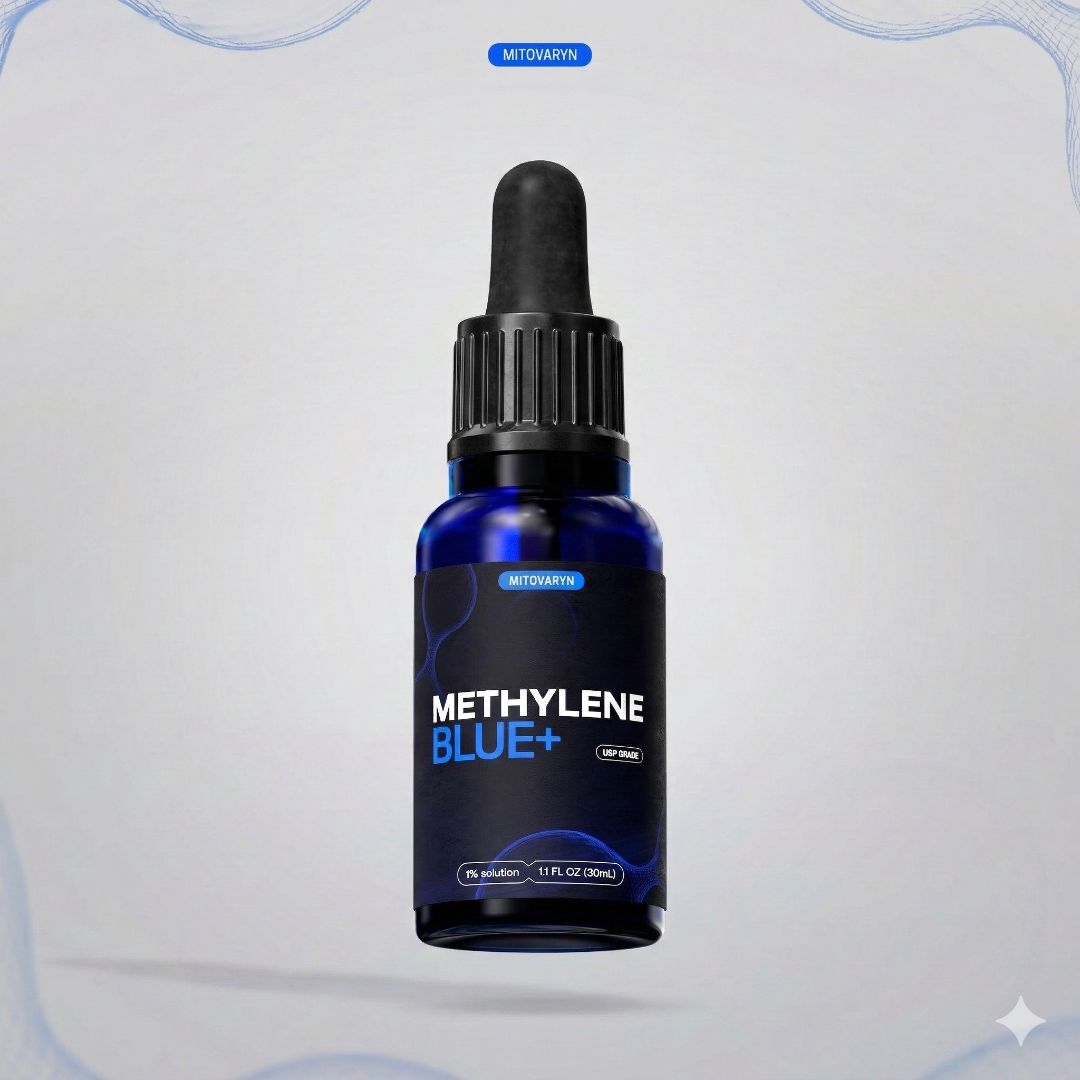 Oral product shown—not a wrinkle cream
No clinical evidence currently establishes methylene blue as a wrinkle treatment. The widely cited 2017 study measured oxidative-stress markers, cell proliferation, tissue hydration, dermal-layer thickness and extracellular-matrix expression in laboratory models. It did not enroll people, grade facial wrinkles or compare a finished product with placebo.
The evidence at a glance
A search of indexed literature through September 2026 identified the 2017 laboratory study as the central methylene-blue skin-aging paper. It did not identify a randomized human trial with facial wrinkles as an outcome.1
| Question | Current answer | Evidence level |
|---|---|---|
| Does methylene blue affect human-derived skin cells? | Yes. Laboratory studies report effects on reactive-oxygen, senescence and extracellular-matrix markers. | Preclinical |
| Was laboratory-grown human skin tested? | Yes. The pivotal paper used reconstructed 3D skin models made from human cells. | In vitro |
| Were wrinkles measured on living people? | No. There were no participants, facial photographs, wrinkle scales or instrumental wrinkle measurements. | No clinical outcome |
| Does a methylene-blue cream reduce wrinkles? | Not established for a finished formula in a controlled human study. | Unproven |
| Does oral methylene blue reduce wrinkles? | No robust human evidence establishes an oral wrinkle benefit. | Unproven |
| Can it replace sunscreen or tretinoin? | No. Those interventions have direct human photoaging evidence; methylene blue does not. | Do not substitute |
Bottom line: methylene blue is a research candidate, not a clinically proven wrinkle solution. A change in a cell marker is not the same result as a visible reduction in crow's-feet, forehead lines or facial wrinkling.
What visible wrinkles actually represent
Wrinkles are not one condition with one upstream cause. Their appearance reflects intrinsic aging, cumulative ultraviolet exposure, repeated facial movement, skin-barrier hydration, volume and structural change, smoking and other factors.
| Pattern | Important contributors | Why it matters |
|---|---|---|
| Fine dehydration lines | Low stratum-corneum water, barrier disruption and surface texture | Moisturizer may soften appearance without rebuilding dermal collagen. |
| Photoaging lines | Cumulative UVA and UVB exposure, collagen disorganization and elastosis | Evidence should involve photoaged human skin, not just cells. |
| Dynamic lines | Repeated muscle contraction around the eyes, brow and forehead | A mitochondrial mechanism does not directly address facial movement. |
| Static creases | Structural remodeling, volume change, laxity and repeated folding | A topical product may have limited ability to change established anatomy. |
| Wrinkle-like texture | Dryness, irritation or inflammation | Treating the barrier may change appearance without affecting biological age. |
Wrinkles are not proof of “low cellular energy.” Mitochondria participate in skin biology, but ATP language cannot diagnose a person's lines or demonstrate that methylene blue will improve them.
What the methylene-blue skin study measured
The pivotal 2017 paper exposed cultured dermal fibroblasts and commercial reconstructed human-skin models to methylene blue.2 It supports further formulation research, but no participant applied a cream and no facial wrinkle was measured.
| Endpoint | Reported result | What it cannot prove |
|---|---|---|
| Reactive-oxygen and senescence markers | Changes in cultured fibroblasts under controlled exposure | Fewer, shallower or slower-developing wrinkles |
| Cell proliferation | Increased growth in selected cell systems | Safer, healthier or younger-looking facial skin |
| Matrix expression | Changes in elastin and selected extracellular-matrix genes or proteins | Clinically meaningful collagen remodeling, firmness or elasticity |
| Hydration and tissue thickness | Higher laboratory hydration readings and fibroblast-layer thickness at selected concentrations | Wrinkle improvement beyond a cream vehicle in people |
| Short irritation test | No viability-defined irritation after 60 minutes in reconstructed tissue | Human facial, eye-area, sensitization or long-term safety |
| Scratch assay | More cell migration into a scraped culture gap | Wrinkle treatment or wound healing in people |
At higher tested concentrations, reconstructed tissues developed blue coloring, and some concentrations reduced viability. “More” was not reliably better.
A genuine wrinkle trial would measure wrinkles: standardized photography, validated clinical grading and surface profilometry, alongside participant-reported outcomes and adverse events. It would compare the exact finished formula with its vehicle for a meaningful duration.
Topical and oral methylene blue are separate questions
The laboratory findings do not support swallowing methylene blue for wrinkles. Route changes exposure, metabolism, tissue concentration, formulation requirements and risk.
| Route or model | What was studied | Invalid leap |
|---|---|---|
| Cell culture | Direct exposure of isolated cells | Assuming an oral dose creates the same exposure in facial skin |
| Reconstructed skin | Topical exposure of engineered tissue | Calling it a clinical facial-use trial |
| Finished topical formula | Must be tested as the exact product sold | Borrowing results across concentrations, vehicles and packaging |
| Oral product | A separate systemic-use evidence and safety question | Claiming collagen, hydration or wrinkle benefits from topical models |
No robust human evidence establishes that oral methylene blue improves facial wrinkles, collagen density, elasticity or perceived skin age. See the anti-aging-cream evidence review for more on topical formulation.
Can methylene blue prevent new wrinkles?
Prevention requires evidence collected before visible aging progresses. No human trial shows that topical or oral methylene blue slows the development of wrinkles over time.
A 2021 laboratory study reported that methylene blue absorbed ultraviolet wavelengths and reduced selected UVB-related damage endpoints in cultured keratinocytes and reconstructed skin.3 This does not provide a tested SPF, UVA protection, sunburn prevention or a clinical photoaging result.
| Claim | What the evidence supports | What remains missing |
|---|---|---|
| “Protects from UV” | Selected protective endpoints in laboratory models | Human SPF, broad-spectrum and real-world exposure testing |
| “Prevents photoaging” | A reason for further research | Long-term human wrinkle or photoaging outcomes |
| “Replaces sunscreen” | Nothing in the study supports substitution | A regulated, tested sunscreen claim for the finished formula |
Do not use methylene blue as sunscreen. A light-absorption mechanism or reconstructed-skin result cannot be converted into an SPF.
What has stronger human evidence for wrinkles?
Evidence strength depends on the exact goal. Prevention, temporary surface smoothing and treatment of established photoaging are different jobs.
| Approach | Evidence-aware role | Important limit |
|---|---|---|
| Broad-spectrum sunscreen | Prevention foundation A randomized trial in 903 adults found 24% less skin aging with daily use over 4.5 years than discretionary use.4 | Amount, coverage, reapplication and other sun-protective behaviors still matter. |
| Topical tretinoin | Human treatment evidence A systematic review of seven randomized trials found improvement in clinical photoaging, including wrinkling.5 | Irritation and pregnancy considerations require appropriate guidance. |
| Moisturizer | Can support the barrier and temporarily soften dehydration-related fine lines. | Surface hydration is not reversal of deep structural wrinkles. |
| Procedures | A dermatologist can match neuromodulators, resurfacing, fillers or other procedures to wrinkle type. | Benefits, risks, cost and suitability vary; licensed assessment matters. |
| Methylene blue | Experimental Mechanistic and reconstructed-tissue findings | No robust human wrinkle trial or standardized topical formula |
Sun protection, avoiding tobacco smoke and treating barrier irritation address known contributors. A changing, bleeding or non-healing lesion is not a wrinkle and needs medical assessment.
Formulation, staining and safety still matter
A finished topical product can behave differently from a pure ingredient in a laboratory. Concentration, vehicle, pH, penetration, oxidation state, light exposure, packaging, preservatives and co-ingredients influence performance and tolerability.
| Issue | Why it matters | Prudent standard |
|---|---|---|
| Concentration | Higher tested concentrations colored reconstructed tissue and some reduced viability. | Do not assume more produces faster wrinkle results. |
| Vehicle | A cream base can improve hydration and fine-line appearance by itself. | Require a vehicle-controlled finished-product study. |
| Staining | Methylene blue is a dye and may discolor skin, nails, hair, fabric or surfaces. | Look for real-world staining and wash-off data. |
| Sensitization and irritation | A short reconstructed-tissue test cannot answer every facial-use reaction. | Look for human tolerability and adverse-event reporting. |
| Oral-product repurposing | Oral specifications do not establish topical stability, penetration, preservation or eye safety. | Do not add Mitovaryn drops to skincare or apply them to the face. |
Methylene blue also inhibits MAO-A and has important systemic contraindications and drug interactions.7 Current prescription labeling highlights serotonin syndrome, G6PD-related hemolysis and pregnancy/lactation considerations.6 An untested topical product without absorption data should not be assumed systemically irrelevant.
How to assess a methylene-blue wrinkle claim
| Question to ask | Credible evidence | Red flag |
|---|---|---|
| Was the exact product tested? | Randomized, blinded, vehicle-controlled human trial | Only citing the 2017 cell and reconstructed-skin paper |
| Were wrinkles actually measured? | Validated clinical scale plus standardized imaging or profilometry | Only ATP, antioxidant, collagen-gene or hydration language |
| Was the change meaningful? | Effect size, confidence interval and participant-reported relevance | A percentage without baseline, comparator or units |
| Was the cream base controlled? | Same vehicle without methylene blue | Uncontrolled before-and-after photographs |
| Were adverse effects disclosed? | Irritation, staining, dropouts and sensitization reported | “Side-effect free” or “safe for everyone” |
| Is the route matched? | Topical claims supported by topical testing; oral claims by oral studies | Using topical tissue data to sell oral wrinkle benefits |
In the United States, claims can influence whether a topical product is regulated as a cosmetic, drug or both. Claims to treat disease or affect body structure or function are not interchangeable with ordinary appearance claims.8
Frequently asked questions
Does methylene blue remove wrinkles?
No robust human clinical evidence shows that methylene blue removes or meaningfully reduces facial wrinkles. Current support comes mainly from cells and reconstructed skin tissue.
Has methylene blue been tested in a human wrinkle trial?
The central 2017 skin-aging study did not enroll people or grade wrinkles. It used cultured human-derived cells and laboratory-grown 3D skin models.
Does methylene blue increase collagen?
The laboratory study reported changes in selected extracellular-matrix genes and proteins. It did not demonstrate clinically meaningful facial collagen remodeling or reduced wrinkle depth in people.
Does methylene blue increase elastin?
Elastin expression increased in reconstructed tissue under selected test conditions. That finding does not establish improved elasticity, firmness or wrinkles in living participants.
Can oral methylene blue improve skin wrinkles?
No robust human evidence establishes that oral methylene blue improves wrinkles, collagen density, elasticity or perceived skin age. Topical laboratory findings cannot be transferred to oral use.
Can Mitovaryn Methylene Blue be applied to the face?
No. Mitovaryn Methylene Blue is an oral product, not a cosmetic serum or wrinkle cream. Do not apply it to skin, mix it into moisturizer or use it near the eyes.
Can methylene blue replace retinol or tretinoin?
No comparative evidence supports replacement. Prescription tretinoin has randomized human photoaging evidence; methylene blue does not have an equivalent wrinkle evidence base.
Can methylene blue replace sunscreen?
No. Experimental UV findings do not establish SPF or broad-spectrum protection. Use a properly tested and labeled sunscreen as directed.
Will topical methylene blue stain skin?
It may. Methylene blue is a dye, and the reconstructed-skin study observed blue coloring at higher tested concentrations. Staining depends on concentration, vehicle and exposure.
Is topical methylene blue safe with antidepressants?
Systemic absorption from an untested formula may be unknown, while methylene blue can inhibit MAO-A and interact seriously with serotonergic drugs. Ask the treating prescriber or pharmacist before use.
What has stronger evidence for preventing wrinkles?
Daily broad-spectrum sunscreen has randomized human evidence for reducing photoaging. Shade, protective clothing and avoiding tobacco smoke also address established contributors.
What should a credible methylene-blue wrinkle trial measure?
It should test the exact finished formula against its vehicle in people, using standardized photographs, validated wrinkle grades, objective surface measurements, participant-reported outcomes and complete adverse-event reporting.
Sources and evidence notes
- PubMed title/abstract search for methylene blue with wrinkles or photoaging. Reviewed September 2026; the relevant skin paper was preclinical.
- Xiong ZM, et al. Anti-Aging Potentials of Methylene Blue for Human Skin Longevity. Scientific Reports. 2017. Cell and reconstructed-tissue study.
- Xiong ZM, et al. Ultraviolet radiation protection potentials of Methylene Blue for human skin and coral reef health. Scientific Reports. 2021. Preclinical evidence.
- Hughes MCB, et al. Sunscreen and prevention of skin aging: a randomized trial. Annals of Internal Medicine. 2013.
- Sitohang IBS, et al. Topical tretinoin for treating photoaging: a systematic review of randomized controlled trials. International Journal of Women's Dermatology. 2022.
- DailyMed: Methylene Blue Injection prescribing information. Updated April 2026. Systemic labeling, not a topical protocol.
- Ramsay RR, et al. Methylene blue and serotonin toxicity. British Journal of Pharmacology. 2007. MAO-A evidence.
- U.S. FDA. Is It a Cosmetic, a Drug, or Both? Intended-use and claims guidance.
Review Mitovaryn Methylene Blue accurately
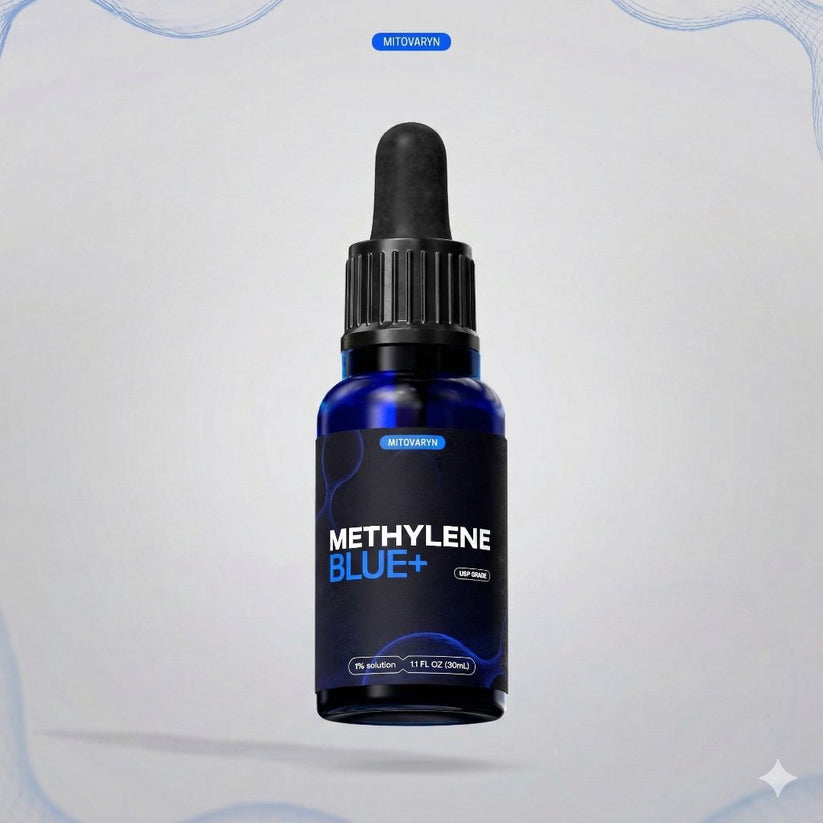
Explore specifications and available documentation for Mitovaryn's oral methylene-blue product. It is not a wrinkle treatment or topical skincare formula.
Medical disclaimer: Educational content only—not medical advice, diagnosis, treatment or a recommendation to apply or ingest methylene blue for wrinkles. Mitovaryn Methylene Blue is not a skin cream. Seek qualified dermatologic or medical guidance for skin concerns, reactions, medication interactions and changing lesions.